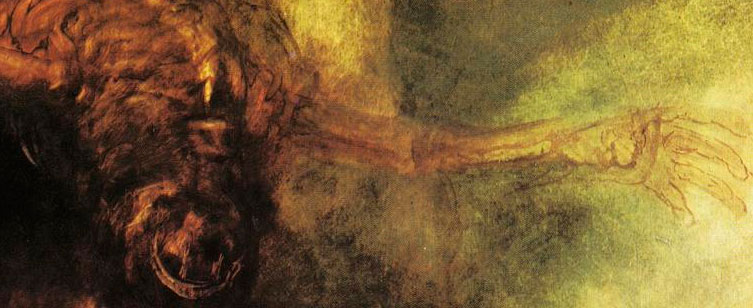
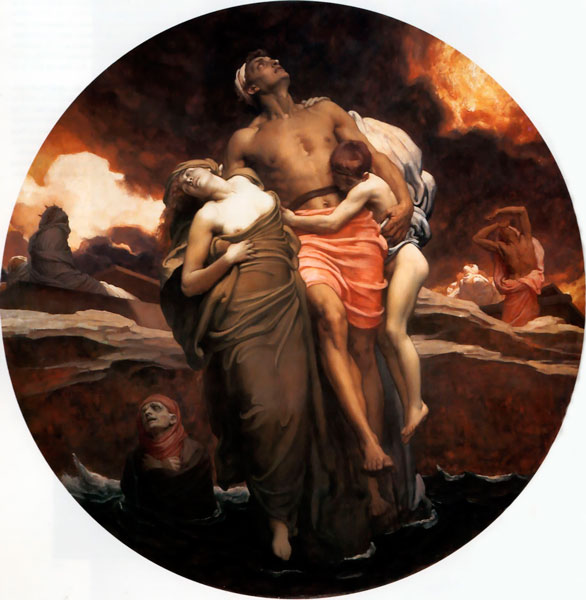
This is Lord Frederick Leighton’s And the sea gave up the dead which were in it (1891, oil on canvas, 90″, much larger link here), a piece that caught my eye when I was looking for something else (which is often the case).

I don’t tend to do biblical pieces all that often, mostly because I’m not a religious person, but also because there tends to be a more structured, more “official” look to many of them.  Now, before both of you (or am I down to one person reading these now) let me have it, I just tend to think that the non-religious art pieces are a little more open, the artist seeming a little more free to do as they wish.  As my friend says though, your mileage may vary.

Leighton has created a large image at 90″ across, which I’ve read was originally intended as ceiling art in St. Paul’s Cathedral (see here for reference). The size and dramatic sense of the piece certainly makes sense then, as does of course the content.  The image shows the last judgment, and is based on Revelations (20th chapter).

Before I say what I think on the content, let’s talk about the artistry.  I like Leighton’s use of color and contrast here.  The colors are all fairly subdued, yet certainly help bring your eye into the work.  You are first drawn to the man in the center (partially because, well, he’s in the center), something that’s helped by his red clothing.  Leighton also uses a fiery palette in other parts, a sense that something otherworldly is happening.

Leighton’s use of contrasts works very well here, and really helps tell the story.  The bright white of the woman’s chest keeps your eye in the center of the work (and not at her body, that’s not what I mean– well maybe some), but the the bright clouds behind her also give a sense of the earth to the image.  At the same time, the midtones of the piece keep your eye from straying too far off the mark, and drives home further impact to the events at hand.

Where I think Leighton worked best was actually in using that contrast and the gray levels to give an idea of what’s happening in the scene. The man in the center, and a number of the people around him are seemingly grayed out, more subtle than the others. The man’s wife in his arm, the boy and even a few of the characters in the back are far brighter, which to me seems to indicate what happened during the judgment, and the final act now in progress.

Along with the bright characters, the characters all seem to indicate, by body language and facial expression, different ideas.  The man in the center, the man on the right and even the darkened woman in the foreground all seem to be worried or anguished, where there’s a sense of relaxation, even rapture in the others.

The piece itself is nicely open to interpretation. To me, Leighton is showing that, as the dead rise again, they are being sent to their final places.  Some to rest, others to damnation.  What strikes me as the pinnacle of the piece is the boy.  I take it that, based on his contrast and color, that he’s rising to heaven.  He’s holding onto his father tightly, not wanting to let him go.  He knows his father isn’t joining them, and it’s his last goodbye as he ascends to heaven.

Opinions?


Tags: , , , , , , ,

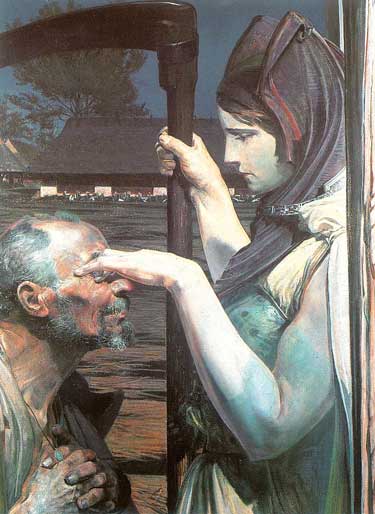
I think where art can be a good thing is the ability to get the feelings and emotions out on the table, without necessarily having to explain all the things you are really feeling.  I’ve always felt that art comes down more to what I want something to look like than any emotional release for myself.  But once in awhile I get into a mood where the only way to express the feelings is through art.

This piece here is a good example of that.  I won’t go into whatever it is that’s bothering me, you folks aren’t interested in such drivel.  It could also be that I’m looking for the road still unfound, and creating the path might be one way to find it.

Now, granted, none of the paths from this crossroad look terribly appetizing. But sometimes you just need to face the darkness, and that’s where art can come in.  Without saying anything, without going into any details, the world is laid bare for those who wish to decipher it.

That all (boringly) said, I’m also trying to sketch everyday.  This certainly counts for that, practice for the future to come.  If it’s not an emotional release, if it’s not life laid open, at the very least it’s an expression of colors and techniques that I hope one day to have mastery, or at least acceptance, over.


Tags: , , , , , , , , ,

Ok, so my “little break” was more like a couple of weeks.  Add “extreme coughing from the lungs” to “Post-Las Vegas” and there you go. But I’m back, and this one is an interesting one for me.  It’s one of the first art pieces that I really took something from, especially in the extreme emotion.

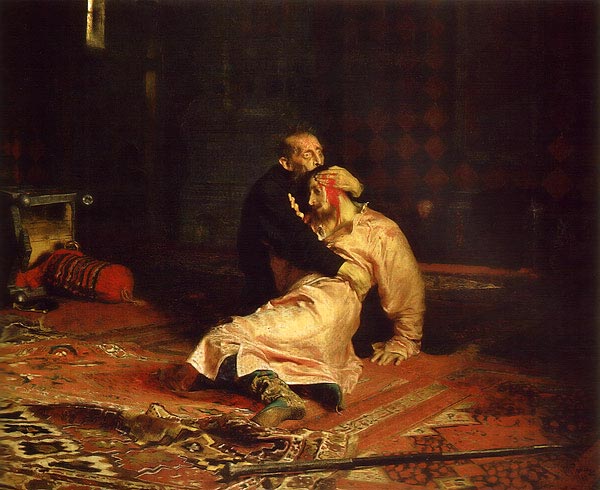
This is Il’ya Repin’s Ivan the Terrible and His Son Ivan on November 16, 1581 (1885, oil on canvas, 79″ x 100″). The artist based it on a real event, involving (natch) Ivan the Terrible.  In the heat of an argument, Ivan stuck his son with his staff, mortally wounding him.

Repin used a very nice composition here, with very little in the background to steal your attention.  The foreground is a fairly nondescript rug, with little furniture in the room either. The only furniture that you can really see is knocked over, adding to the drama of the moment.  I like is the posing of the characters too, there’s little life left in the son, but he hasn’t passed on just yet.  Ivan is holding his son tightly, and holding his hand across the wound, as if trying to hold his son here on earth as long as he can.

Along with the composition, Repin brought the contrast into only the center of the piece, leaving the rest of the image to fall off into the darkness or into similarly colored areas.  There’s a strong sense to me that the light is actually knocked over, as the shadows that are being cast seem to come from a low spot.  It adds to the drama of the scene, and to the desperation in it.

The palette of colors he uses works well, and he put it in just the right spots.  Red is quite primary in the image, but it sits mostly around the exterior of the image. It’s almost a frame of red, surrounding and even highlighting the blood on the younger Ivan’s face. Your eye is brought right to the blood in the center, and right to the shock on Ivan’s face, a face of madness and horror.

Though certainly, without an actual photograph of the event, there’s no real way to know what happened in that moment.  But Repin has captured a believable emotion perfectly, as Ivan is hit full bore with the realization that in his uncontrollable rampage he has killed his own son. Ivan’s face shows the full horror of his actions, a perfect rendition of going too far, and realizing that you can never take it back.

Opinions?

Russ


Tags: , , , , , , , , , , , , , , , ,

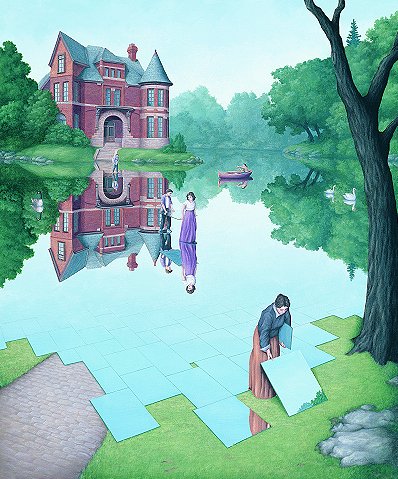
This is Rob Gonsalves’ Still Waters, truly an impressive piece of art.  It’s one of the most interesting styles I’ve seen, and it’s fascinating to look at.

I’ve always loved the unique visions of artists like Magritte and Escher, who seem to be able to easily twist reality and yet keep beauty intact. Gonsalves has certainly done that here, and the technique is described on sites featuring his work as “magic realism”.  I think that’s a great tag for it, it’s art that is completely real if you are looking at either part separately, and as a whole is still seemingly connected despite it’s differences.

It’s impressive alone that an artist has such a good grasp of perspective, and of the “rules” that are taught in art.  The most impressive thing here is that Gonsalves knows exactly what the rules are but where and how to twist them into a dual reality.  It’s as if the two ideas in the picture have melded together, and where they meet or even end is anyone’s guess.

I think the palette he chooses here really helps the effect, and doesn’t detract from it.  It’s a sharp, detailed look, but the colors are soft and engaging.  By keeping the contrast a bit lower your eye isn’t drawn to any particular part, but the whole.  The viewer can easily lose themselves in either reality, or even one of magic.

Gonsalves has created a masterwork, a piece comfortable in both it’s reality and fantasy.  It’s what art is supposed to be: engaging, thought provoking and something that sticks with you for times to come.

Opinions?

Russ

ps – see more of Rob Gonsalves work at http://www.robgonsalves.com/ArtistGallery.asp?artist_id=23&category_id=2


Tags: , , , , , , , , , , , ,

Powered by Wordpress
Theme adapted by Russell Dickerson from BlueMod (blueblog_DE Theme by Oliver Wunder)
Original Theme © 2005 - 2009 FrederikM.de

Switch to our mobile site