I thought I would return to the pulp art era again, I have a wonderful book by Robert Lesser called, simply, Pulp Art, which is fantastic. I think many of the artists in the book really set the stage for illustration art ever since, and I wanted to write a few blogs about them.

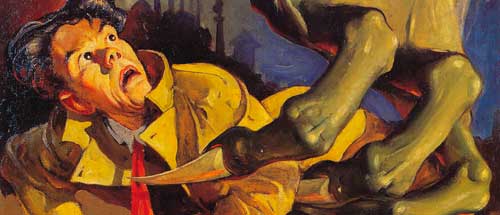
This is Edd Cartier’s cover for Unknown Fantasy Fiction, December 1939, and is a striking piece in both execution and in idea. There’s a real dramatic sense to the art, and it really would pull me in to read what’s inside.

I like Cartier’s use of color and contrast here. I think the bright yellow of the man’s jacket in the foreground fades nicely back along the green arm, back into the darkness.

There’s a real sense of depth here, and of a sense that (aside from the obvious claw) this isn’t a normal scene. Cartier uses the brightness and sharpness in the foreground to really help give us a sense of scale, letting the background blur and fade out nicely.

I like that the character’s face has a uniqueness to it as well, and that it’s not necessarily a “production” face.  You come away with the idea that this is an individual, that there’s a story here to follow. Cartier doesn’t just give us a generic victim, he gives us a unique person with a unique (although probably shortened) story.

Above all though, I just like the idea of the art and how it was executed.  I see it that this poor guy was knocked down, and was getting up in relative safety while the events in the background unfold.  As he starts to get up BAM! GIANT GREEN HAND TO MESS UP YOUR NIGHT!

That’s what I like about many of the pulp pieces, and especially this one.  There’s a story here, something that happened, or is about to happen (poor guy). If I saw this cover nowadays I would be drawn right to it, and in a cover you can’t ask for anything else.

Opinions?

ps – The image above comes from Lesser’s Pulp Art book, which is a fantastic tome on the sometimes forgotten, but brilliant art of the pulp era.  I highly suggest you pick it up, try here for starters.


Tags: , , , , , , , , , , , , ,


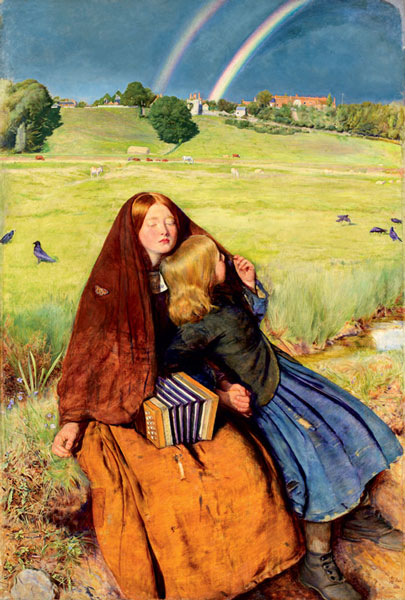
We’re back on a single piece of art this week (since I couldn’t decide on a different topic), this time it’s John Everett Millais’ The Blind Girl (Oil on canvas, 1854-1856, 32 1/2″ x 24 1/2″). It’s one of those pieces where the title really does impact what you see in the image, or at least makes it clear.

It’s an image of duality, of great beauty but of disturbing meaning.  A first glance is a visual feast, showing the beauty of nature, the unusual double rainbow that’s hard to come by in real life, and even the beautiful butterfly on the girl’s shoulder.  But it’s there that you start to realize that the girl in the orange dress can, cruelly, never enjoy the beauty around her. She is blind, and will never know the wonder that it around her. Even the smaller girl in her lap is a cruel twist, as she is fascinated by the environment, alone in her wonder.

Millais really uses a nice color palette and the contrast of the art to set a gorgeous scene.  Bright blue skies, ever flowing fields of green, even the brighter (if worn) blue dress of the smaller girl give such a bright sense to the art that you can’t help but think of a perfect day.  Even the blind girl’s dress is a soft shade of orange, almost teasing her with the brightness she will never see.

For me, Millais’ work always has wonderful detail work, and usually in natural settings. This one is no different, as Millais offers not only great details in the foreground, but a nice, even detail through the background as well. It’s not overpowering, but gives a sense of reality to the work.  What works best is that Millais knew where to soften that detail, knowing that the lack of details in the right areas will enhance the piece.

What I like most in the piece is just the idea that a second look at it, with more information, really sets it apart.  Many might just walk right on by it, noting the beauty of it and moving along.  It’s only on further thought, on further knowledge, that we find out that sometimes even the most beautiful things can really be dark.

Opinions?

Russ


Tags: , , , , , , , , , , , , , , , , , ,


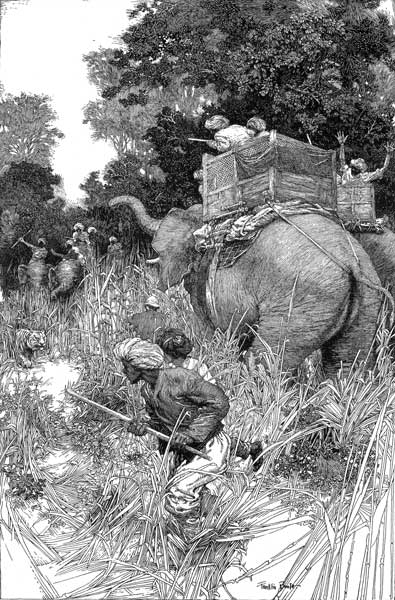
This week we’re back to a piece of art, in this case Franklin Booth’s War on the Tiger (ink, 1908). I’m a huge fan of ink and engraved works, and Booth was a master of the pen.  He is one of the most influential ink artists ever, and his techniques and styles can easily be seen among the best of today’s pen and ink artists.

I happened upon a book about Booth last week, called Franklin Booth: Painter with a Pen, and I think that’s a perfect way to describe his work.  This piece, War on the Tiger, really stood out as soon as I saw it.  It’s a great exercise for ink artists to examine, a wonderful piece that defines perfection in inkwork.

One of the toughest things about doing inkwork is the balance between the detail work and the contrast of the overall image.  Often inked works will suffer from too much detail, and the overall idea or image that was intended is lost in the process.  In this image, Booth shows how to work with the dark and light images of the overall work, and yet not lose detail where it matters.  The lightness in the lower left corner compliments the darkness of the upper right, and both converge right where the action is, at the tiger.

In fact, all of the action in this piece is aimed squarely at the tiger.  The people and animals are all pointed towards it.  The inkwork is designed to lead your eye to it.  Even the strong details and areas of light details all converge at the same spot.  This is actually where Booth succeeds, his greatest idea of all.  He’s built tension in the image, mostly in your subconscious, and his techniques give you a sense of urgency and of swift action that is difficult to pull off.

For me, again a big fan of inkwork, his draftsmanship is beautiful.  From the delicate linework in the character’s clothing, to the detailed look of the far off forest, to the intricately balanced but clean grasses in the foreground, Booth shows a masterful control of the ink and line.  That’s certainly an artist’s sight, looking at the linework and technique.  But I think Booth gives a nice, clean look to the whole piece, which anyone can appreciate over a messier, but maybe even further detailed piece.

Above all, Booth gives you a sense of the scene and of the action long before you start noticing technique.  This is a moment of truth, the men against the tiger, and within the grasses and natural environment seemingly against nature itself.  You get the excitement of the scene, the tension of the story within, and you can ask nothing more from a great artist.

Opinions?

Russ


Tags: , , , , , , , , , , , , , , , , ,

After a busy (and depressing) holiday season, I’m attempting to restart the art blog idea.  This time though, I’m going to work things a little differently. Instead of just a piece of art each week, I’m going to alternate on artistic ideas.  Some weeks will still be about a certain piece, other weeks about artists or books/graphic novels, and other various art-related themes.  Hopefully people will still tune in.

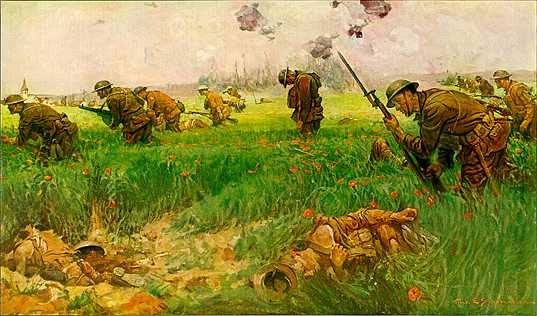
For the first of the new year, I’m talking about Frank E. Schoonover’s “Assault on Belleau Wood“, also known as “How Twenty Marines Took Bouresches” (oil, early 20th century). Schoonover was one of the great illustrators of the early 20th century, a student and friend of Howard Pyle.

In this piece, Schoonover shows a battle from World War I (information on the battle can be seen at http://www.worldwar1.com/dbc/ct_bw2eng.htm), and also showcases his wonderful abilities at realism and storytelling. There is a sense of action and tension in the art, as if we are seeing a certain moment in the story. The men all seem to be waiting for the next shot, the one that might have their name on it.

Schoonover does however give the scene almost a moment of pause to reflect on the dead at the front of the scene.  The body towards the left seems to have been there before, but the one in the foreground (right) seems to have just fallen, as indicated by the man directly above him.  Schoonover has succeeded in giving us a realistic moment of time, and includes the complexity that a real moment would have.

I like the composition of this piece quite a bit, I think Schoonover really draws in the story with it.  The open area between the lines of men is almost the line between life and death. The open, lighter area gives way to the dark figure in the center, one that we assume is either hanging on or has died right as the moment happened. The composition also curves in all respects towards the left, as if saying that the men are all moving forward, regardless of what’s about to happen.

I can’t speak to the color too much unfortunately, there are several versions online and the colors are slightly different in each.  In each though (especially in this version) there seems to be a brightness to the grasses and flowers, to me saying that horror and darkness can invade anywhere.  Even in the beauty of nature, the darkness of war can come.

Opinions?

Russ


Tags: , , , , , , , , , , , , ,

Ok, so my “little break” was more like a couple of weeks.  Add “extreme coughing from the lungs” to “Post-Las Vegas” and there you go. But I’m back, and this one is an interesting one for me.  It’s one of the first art pieces that I really took something from, especially in the extreme emotion.

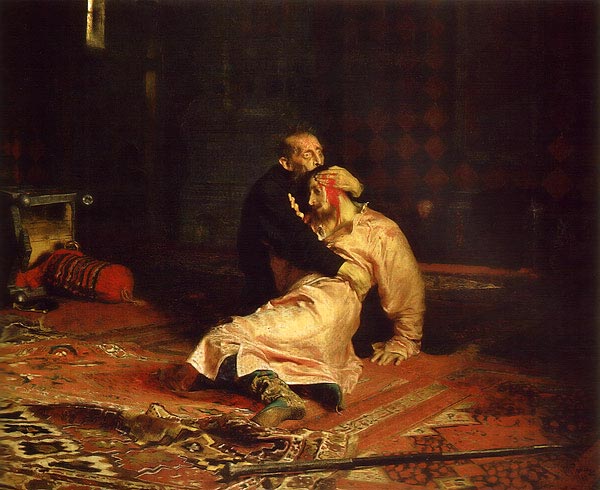
This is Il’ya Repin’s Ivan the Terrible and His Son Ivan on November 16, 1581 (1885, oil on canvas, 79″ x 100″). The artist based it on a real event, involving (natch) Ivan the Terrible.  In the heat of an argument, Ivan stuck his son with his staff, mortally wounding him.

Repin used a very nice composition here, with very little in the background to steal your attention.  The foreground is a fairly nondescript rug, with little furniture in the room either. The only furniture that you can really see is knocked over, adding to the drama of the moment.  I like is the posing of the characters too, there’s little life left in the son, but he hasn’t passed on just yet.  Ivan is holding his son tightly, and holding his hand across the wound, as if trying to hold his son here on earth as long as he can.

Along with the composition, Repin brought the contrast into only the center of the piece, leaving the rest of the image to fall off into the darkness or into similarly colored areas.  There’s a strong sense to me that the light is actually knocked over, as the shadows that are being cast seem to come from a low spot.  It adds to the drama of the scene, and to the desperation in it.

The palette of colors he uses works well, and he put it in just the right spots.  Red is quite primary in the image, but it sits mostly around the exterior of the image. It’s almost a frame of red, surrounding and even highlighting the blood on the younger Ivan’s face. Your eye is brought right to the blood in the center, and right to the shock on Ivan’s face, a face of madness and horror.

Though certainly, without an actual photograph of the event, there’s no real way to know what happened in that moment.  But Repin has captured a believable emotion perfectly, as Ivan is hit full bore with the realization that in his uncontrollable rampage he has killed his own son. Ivan’s face shows the full horror of his actions, a perfect rendition of going too far, and realizing that you can never take it back.

Opinions?

Russ


Tags: , , , , , , , , , , , , , , , ,

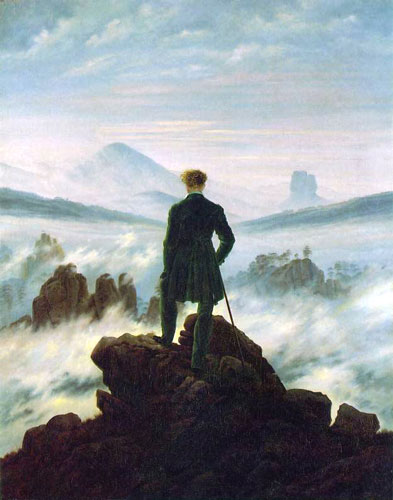
This week it’s one of my very favorite pieces, and one from the previous incarnation of the “This Week’s Art” threads. This is Caspar David Friedrich’s A Wanderer Above a Sea of Mist, a stunning piece for me and one that I will eventually (when I have wallspace) show proudly on my own wall.

For me, this is one of those pieces that shows the pinnacle of what can be achieved in art.  There’s plenty of detail here, but it’s forgotten in the simplicity and strength of the content in the image.  I feel Friedrich was trying to get across what it’s like to have the creative spark inside, to come up to the edge of reality and see that there is far more than you thought was there.

Many have pointed this to be the perfect image for the Romanticism movement of the early 19th century, and I would agree.  The Romanticists wanted to bring emotion and strength back into an art marketplace that had been increasingly becoming more strict and more refined.  They yearned for a looser, more natural, and more emotional vision in art, and Friedrich’s piece here is perfectly representative of that.

We are looking through the eyes of the artist, or at least how he seems himself, and Friedrich uses composition very well to enhance his presentation. The structure and forms of the man, coupled with the angles in the distance, bring your eye right back to the man each time.  He places the full darkness at the bottom of the image, and with the strong light colors above it keeps your eye in check, and aims it where it’s supposed to be.

Friedrich also uses his spare colors and tones wonderfully, and they give an overall sense of depth.  The strong tones of the foreground, what I would consider the artist’s “reality”, give way to the soft, yet breathtaking valley below. It’s a good example of where a small use of color can go a long way.  He uses just the slightest tones for hills and trees in the fog, which grounds us in the creative air of the fog.

For the artist in me, this is what I hope to see in my mind when I’m working on art.  I hope to come up to my own cliff, to the edge of my own reality, and look deep into the abyss.  Friedrich here has allowed just that, a glimpse into the vastness of creativity, and yet a clear grounding throughout.  He seems to say that we must always go the the edge to find out who we are, and that there is no limit to what we might find there.

Opinions?

Russ


Tags: , , , , , , , , , , , , , , ,

In many a year ago, I was an architectural engineering student.  I loved architecture, but I grew to hate number crunching (which is why I’m a silly artist-type now).  But I still appreciate architecture, and this piece is a fantastic view of it.

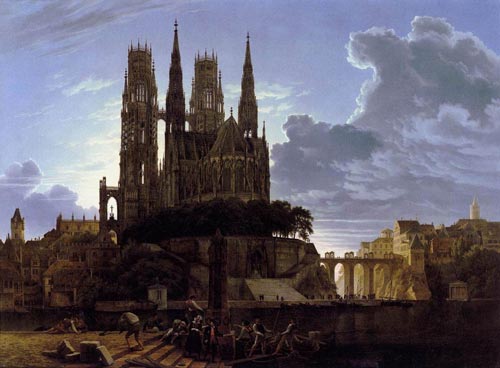
This is Karl Friedrich Schinkel’s Medieval Town by Water (1813, oil, 94 cm x 126 cm), a great architectural piece I came across just today. A piece that for me sits on a nice border between reality and fantasy.

Let’s start with the easy part: I love the cloud work.  The clouds are so dynamic and lifelike, to me more like a photograph.  Schinkel has perfectly captured a moment in time in the clouds, but with a sense that they haven’t stopped any movement at all, the viewer has. They lead perfectly into the cathedral, bound to reality and somehow above it as well.

In dampening the palette of the cathedral, as opposed to highlighting it as other works are, Schinkel has built a powerful structure. Set in the clouds and the setting sun, it sits regally above all else, the fantastical spires ever reaching into the heavens.  Yet, but subduing the palette and giving the cathedral earthy tones, he has also grounded it in reality, grounded it with us mere mortals.

Schinkel does a great job with the immensity of the image, yet through the overall palette and the layout of the piece keeps the view from flying away.  We have everyday people in the foreground, setting reality close at hand.  We have the tiny figures before the cathedral, giving us a sense of scale. Finally, we have the town surrounding the great jewel of the cathedral in its midst, and yet it still seems both above the town and a part of it at once.

Schinkel’s image points to a passion for architecture.  He was a well known architect in Germany at the time, and it seems that if he couldn’t build one to the heavens, he could certainly paint it that way.

Opinions?

Russ


Tags: , , , , , , , , , , , , , ,

Powered by Wordpress
Theme adapted by Russell Dickerson from BlueMod (blueblog_DE Theme by Oliver Wunder)
Original Theme © 2005 - 2009 FrederikM.de

Switch to our mobile site