I dabble a bit in photography, something I’ve always found to be fun.  I don’t (yet) have the fancy cameras, but I still like to do it.  I think, especially being an artist and a graphic designer, I have a decent eye for composition.

I also like dabbling with duotones when I’m working with photos.  Full color is fun, but I really like altering the perception of an image based solely on it’s color. If you aren’t familiar with the idea, images can be (and this is really simplifying things) full color, grayscale (“black and white” to most  people), and toned. “duotoned” as in two colors, “tritone” as in three colors, and so on.

To duotone something (and I just call it duotoning, your mileage, as my friend says, may vary), you take either a grayscale photo or a color photo that you’ve removed the color from, and add only one other color to enhance the black.

For example, here’s a photo that I duotoned. It uses the first color of black, and the second color of a sort of rusty/orangey color:

You get a certain emotion, a certain feeling from this photo.  I’m shooting for historical, maybe patriotic in a sense, but something different than the full color version.  Here’s the full color version, and while I like it I think the duotone gives it something extra:

The color photo is a decent photo, and still dramatic (I think).  But the duotone adds something else to it, something that’s not necessarily there in the full color original.

Here is another one that I duotoned using a different effect.  In this case, the image is really two layers in Photoshop.  One layer is a blue and black duotone, and the other is a yellow and black duotone.  By laying one on top of the other, and using Photoshop’s blending modes and masking abilities, it looks like this:

I purposely left it a little flat, to give it a more “matte” effect.  That’s the beauty of Photoshop, as I could easily have given it a more contrasted, harsher feel, and it would still add a great drama to it:

This feels more militaristic, like there’s a battle being fought (or about to be).  I like that Photoshop can leave it up to the artist to covey what they want, in whatever method they feel.

All in all, I just like taking the photos.  Here are a couple of others that I thought came out nicely.

Opinions, as always, are welcome.


Tags: , , , , , ,

I decided to update my Deviant Art page (at audentiori.deviantart.com), and I thought I’d post the revised art here as well. They are all simply duotoned and recolored for a different purpose, but it brings them each a different look and feel too.


Tags: , , ,

I posted one photo to each of my duotone and photography sections.  The two images also appear below:

They are both from Wilson’s Creek National Battlefield, near Springfield, Missouri.  It was a great trip overall, and I liked visiting the battlefield.


Tags: , , , , ,

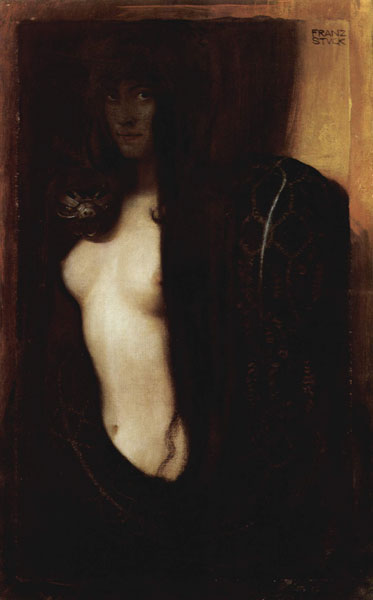
This is Franz Von Stuck’s Sin (1893, Oil on canvas, 35″ x 21″), which may get my vote for having perhaps the most accurate title of an art piece I’ve seen.

I like the color choices and palette here that Von Stuck used, or rather a lack thereof.  He keeps the colors simple, nearly a duotone.  What he does use for color throughout, due to it’s similarity, is a feeling of almost looking at the woman’s skin even when you’re not.  The colors around the outside are similar in shade and tone to the woman’s body, and it’s a temptation woven into the image. Even when you aren’t taking a look at her body, you still get the sense you’re looking into something seductive or even dark.

Von Stuck uses the composition well, though it’s a simple piece. In many pieces, the artist (any artist) would be tempted to make the woman’s head or even the snake’s head be the center of attention. The higher contrast would normally be there with the faces, and it would be set in a more accessible place.  But Von Stuck’s idea held simply to the inner thoughts of man, that when it comes to sin, you’re going to look at the body and damn the consequences.  By placing the more ominous, even the more intelligent parts, to the darkness, and highlighting so brightly the body, the viewer is led to give into the very title of the piece.

The menacing snake (the extra bright closeup to the right) would be a bit much in some scenes, but I think in this one Von Stuck did well by placing it in the shadows.  The woman’s face is still of the temptress, but the snake’s face is all about evil.

I think that in this piece, Von Stuck has done something that can be very difficult in art: to (nearly) perfectly capture a human emotion.  You (ok, mostly men here I’d bet) are drawn right to woman’s body, to the promise of lust, and to the seduction in the darkness of her face.  Von Stuck made it difficult to look away, even with the darkness and the evil so obviously present.  In that effect, he captured sin perfectly.  You know it’s wrong, but not even the snake’s going to stop you.

Opinions?

Russ


Tags: , , , , , , , , , , , , , , ,

Powered by Wordpress
Theme adapted by Russell Dickerson from BlueMod (blueblog_DE Theme by Oliver Wunder)
Original Theme © 2005 - 2009 FrederikM.de

Switch to our mobile site