I’m in the middle of moving this month to a new house (yay me!), complete with an office (and a door), so these posts are a little spotty.  But I’ll try and keep up with them.

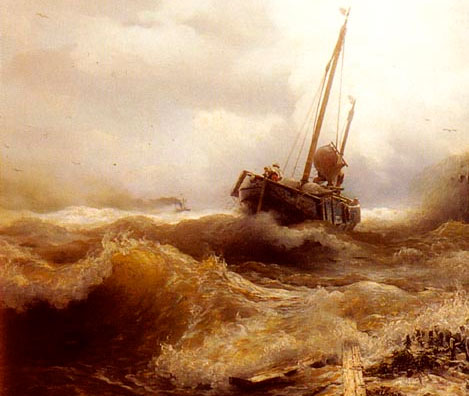
The above work is Andreas Achenbach’s A Fishing Boat Caught In A Squall Off A Jetty (1865, oil on canvas, 38″ x 55″), a piece that caught my attention when I was looking for the last art blog piece.  It’s a very dramatic piece, something I’m always apt to appreciate.

I think this piece grabs me for a few reasons.  First off, the color palette.  With photography, I’m a big fan of sepia tones.  It gives you an older, almost worn look that smacks of age.  I think the sepia palette here definitely works in its favor, giving not only a sense of age but that this was an entirely different era.  You get the sense that Achenbach captured a real moment, a real-life drama played out right in front of the artist.

There’s a strong sense in the work of nature vs. humanity, and it gives it a sharp dramatic sense.  The smooth lines of the man-made structures give way to the randomness of the waves and the sky. Each side seems almost to be taunting the other, and we’re not sure if man will have his dock or if it will all be swept away.

For me, that’s the strongest point of the work.  This isn’t just a wave coming in, or the rising tide.  The water is alive, and is fighting everything in its path. Not just the boat, but the people and maybe even the dock itself don’t seem to stand a chance against the violent waves.

Some of my favorite artists and works offer a glimpse of a different world, or different time.  Some of them make nature seem alive, and in some cases threatening.  I think this piece captures all of that.  Nature is rushing ashore with unstoppable power, and pity anything that stands in its way.

Opinions?


Tags: , , , , , , , ,

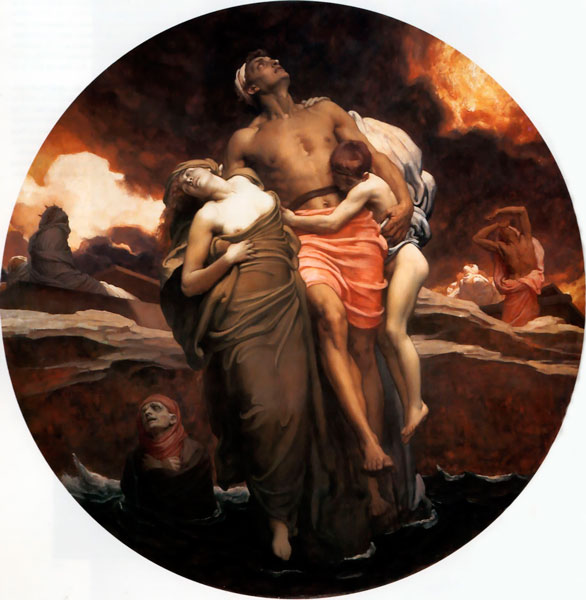
This is Lord Frederick Leighton’s And the sea gave up the dead which were in it (1891, oil on canvas, 90″, much larger link here), a piece that caught my eye when I was looking for something else (which is often the case).

I don’t tend to do biblical pieces all that often, mostly because I’m not a religious person, but also because there tends to be a more structured, more “official” look to many of them.  Now, before both of you (or am I down to one person reading these now) let me have it, I just tend to think that the non-religious art pieces are a little more open, the artist seeming a little more free to do as they wish.  As my friend says though, your mileage may vary.

Leighton has created a large image at 90″ across, which I’ve read was originally intended as ceiling art in St. Paul’s Cathedral (see here for reference). The size and dramatic sense of the piece certainly makes sense then, as does of course the content.  The image shows the last judgment, and is based on Revelations (20th chapter).

Before I say what I think on the content, let’s talk about the artistry.  I like Leighton’s use of color and contrast here.  The colors are all fairly subdued, yet certainly help bring your eye into the work.  You are first drawn to the man in the center (partially because, well, he’s in the center), something that’s helped by his red clothing.  Leighton also uses a fiery palette in other parts, a sense that something otherworldly is happening.

Leighton’s use of contrasts works very well here, and really helps tell the story.  The bright white of the woman’s chest keeps your eye in the center of the work (and not at her body, that’s not what I mean– well maybe some), but the the bright clouds behind her also give a sense of the earth to the image.  At the same time, the midtones of the piece keep your eye from straying too far off the mark, and drives home further impact to the events at hand.

Where I think Leighton worked best was actually in using that contrast and the gray levels to give an idea of what’s happening in the scene. The man in the center, and a number of the people around him are seemingly grayed out, more subtle than the others. The man’s wife in his arm, the boy and even a few of the characters in the back are far brighter, which to me seems to indicate what happened during the judgment, and the final act now in progress.

Along with the bright characters, the characters all seem to indicate, by body language and facial expression, different ideas.  The man in the center, the man on the right and even the darkened woman in the foreground all seem to be worried or anguished, where there’s a sense of relaxation, even rapture in the others.

The piece itself is nicely open to interpretation. To me, Leighton is showing that, as the dead rise again, they are being sent to their final places.  Some to rest, others to damnation.  What strikes me as the pinnacle of the piece is the boy.  I take it that, based on his contrast and color, that he’s rising to heaven.  He’s holding onto his father tightly, not wanting to let him go.  He knows his father isn’t joining them, and it’s his last goodbye as he ascends to heaven.

Opinions?


Tags: , , , , , , ,

I thought I would return to the pulp art era again, I have a wonderful book by Robert Lesser called, simply, Pulp Art, which is fantastic. I think many of the artists in the book really set the stage for illustration art ever since, and I wanted to write a few blogs about them.

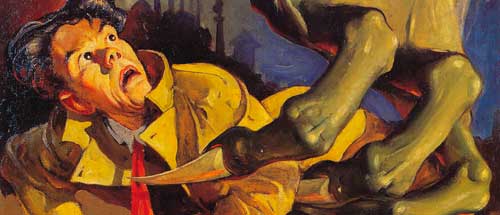
This is Edd Cartier’s cover for Unknown Fantasy Fiction, December 1939, and is a striking piece in both execution and in idea. There’s a real dramatic sense to the art, and it really would pull me in to read what’s inside.

I like Cartier’s use of color and contrast here. I think the bright yellow of the man’s jacket in the foreground fades nicely back along the green arm, back into the darkness.

There’s a real sense of depth here, and of a sense that (aside from the obvious claw) this isn’t a normal scene. Cartier uses the brightness and sharpness in the foreground to really help give us a sense of scale, letting the background blur and fade out nicely.

I like that the character’s face has a uniqueness to it as well, and that it’s not necessarily a “production” face.  You come away with the idea that this is an individual, that there’s a story here to follow. Cartier doesn’t just give us a generic victim, he gives us a unique person with a unique (although probably shortened) story.

Above all though, I just like the idea of the art and how it was executed.  I see it that this poor guy was knocked down, and was getting up in relative safety while the events in the background unfold.  As he starts to get up BAM! GIANT GREEN HAND TO MESS UP YOUR NIGHT!

That’s what I like about many of the pulp pieces, and especially this one.  There’s a story here, something that happened, or is about to happen (poor guy). If I saw this cover nowadays I would be drawn right to it, and in a cover you can’t ask for anything else.

Opinions?

ps – The image above comes from Lesser’s Pulp Art book, which is a fantastic tome on the sometimes forgotten, but brilliant art of the pulp era.  I highly suggest you pick it up, try here for starters.


Tags: , , , , , , , , , , , , ,

Powered by Wordpress
Theme adapted by Russell Dickerson from BlueMod (blueblog_DE Theme by Oliver Wunder)
Original Theme © 2005 - 2009 FrederikM.de

Switch to our mobile site