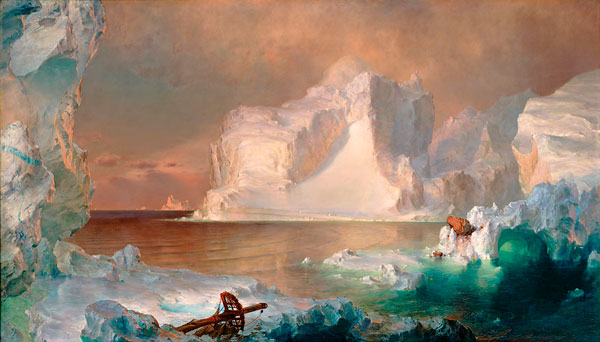
This is Frederic Edwin Church’s The Icebergs (1861. Oil on canvas, 64-1/2″ x 112-1/2″, large size here), and for most of the people who read this blog (anyone? anyone at all?) you may be reminded of Dan Simmon’s recent book The Terror.

Rightly so, as both were influenced (or actually, about, in the case of the book) by the ill-fated Franklin expedition. Though the painting itself is not directly about the lost Franklin expedition (ok, go read about it here, I’ll wait…), Church certainly had it in mind when he painted the picture.

Unlike most of the images I’ve featured here, this one doesn’t have the impact of having an actual person or character in it.  But what it lacks in an actual character it more than makes up for in the inference that people have been here, and seem to have met an untimely end.

In many images of the colder areas of the world, the ice and surrounding terrain are simply part of the landscape, and in fact Church does that here as well in the top left side of the image.  He uses warmer colors to show the area at sunset, and, even in the apparent cold, there’s a warmth here in his palette choices.  The work is soft, almost inviting.

As you work your way down and to the right, any feelings of warmth or comfort give way to darkness, and a strong sense of foreboding.  Church’s hues change radically from warm to cool, the harsh, alien blue of the ice tossing out whatever softness existed above it.

Church also used detail work and contrast to his advantage, much in the same ways he used color.  The loose, soft brush strokes of the easy afternoon above give way to the sharp, high detail of the foreground.  The ice becomes sharp and imposing, the soft waves become hard, as you are lulled from the calm waves to the death on the ice.

The seemingly forgotten mast in the lower right is more the icing (sorry, had to be said) on the cake.  It’s not a forceful detail, it’s a small piece of a massive work (almost 10 feet wide), but your attention goes right to it.  This is the lost expedition, a tiny bit left within a humongous nature.

What I like most about this piece is that it tells you everything without bashing you in the face with it. Church used colors, contrast and minor details to create a very dramatic piece.  It’s up to the viewer to decide how harsh it is really, whether it’s the horror of the expedition’s destruction, or perhaps the peace of the men within after their fall.

Opinions?


Tags: , , , , , , , ,


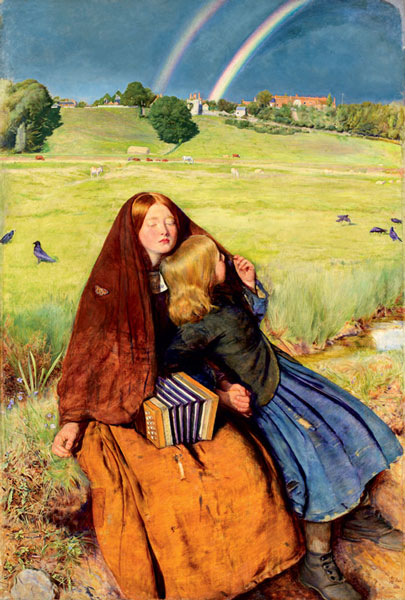
We’re back on a single piece of art this week (since I couldn’t decide on a different topic), this time it’s John Everett Millais’ The Blind Girl (Oil on canvas, 1854-1856, 32 1/2″ x 24 1/2″). It’s one of those pieces where the title really does impact what you see in the image, or at least makes it clear.

It’s an image of duality, of great beauty but of disturbing meaning.  A first glance is a visual feast, showing the beauty of nature, the unusual double rainbow that’s hard to come by in real life, and even the beautiful butterfly on the girl’s shoulder.  But it’s there that you start to realize that the girl in the orange dress can, cruelly, never enjoy the beauty around her. She is blind, and will never know the wonder that it around her. Even the smaller girl in her lap is a cruel twist, as she is fascinated by the environment, alone in her wonder.

Millais really uses a nice color palette and the contrast of the art to set a gorgeous scene.  Bright blue skies, ever flowing fields of green, even the brighter (if worn) blue dress of the smaller girl give such a bright sense to the art that you can’t help but think of a perfect day.  Even the blind girl’s dress is a soft shade of orange, almost teasing her with the brightness she will never see.

For me, Millais’ work always has wonderful detail work, and usually in natural settings. This one is no different, as Millais offers not only great details in the foreground, but a nice, even detail through the background as well. It’s not overpowering, but gives a sense of reality to the work.  What works best is that Millais knew where to soften that detail, knowing that the lack of details in the right areas will enhance the piece.

What I like most in the piece is just the idea that a second look at it, with more information, really sets it apart.  Many might just walk right on by it, noting the beauty of it and moving along.  It’s only on further thought, on further knowledge, that we find out that sometimes even the most beautiful things can really be dark.

Opinions?

Russ


Tags: , , , , , , , , , , , , , , , , , ,


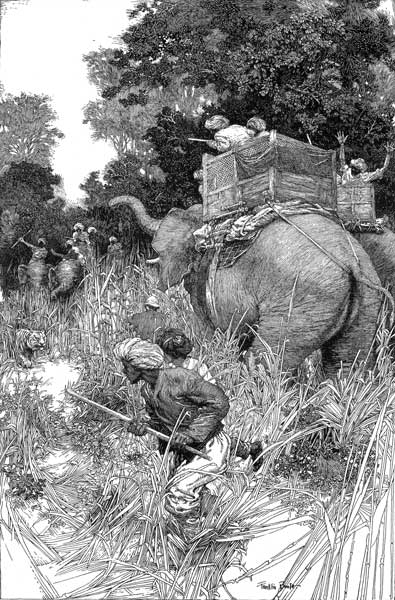
This week we’re back to a piece of art, in this case Franklin Booth’s War on the Tiger (ink, 1908). I’m a huge fan of ink and engraved works, and Booth was a master of the pen.  He is one of the most influential ink artists ever, and his techniques and styles can easily be seen among the best of today’s pen and ink artists.

I happened upon a book about Booth last week, called Franklin Booth: Painter with a Pen, and I think that’s a perfect way to describe his work.  This piece, War on the Tiger, really stood out as soon as I saw it.  It’s a great exercise for ink artists to examine, a wonderful piece that defines perfection in inkwork.

One of the toughest things about doing inkwork is the balance between the detail work and the contrast of the overall image.  Often inked works will suffer from too much detail, and the overall idea or image that was intended is lost in the process.  In this image, Booth shows how to work with the dark and light images of the overall work, and yet not lose detail where it matters.  The lightness in the lower left corner compliments the darkness of the upper right, and both converge right where the action is, at the tiger.

In fact, all of the action in this piece is aimed squarely at the tiger.  The people and animals are all pointed towards it.  The inkwork is designed to lead your eye to it.  Even the strong details and areas of light details all converge at the same spot.  This is actually where Booth succeeds, his greatest idea of all.  He’s built tension in the image, mostly in your subconscious, and his techniques give you a sense of urgency and of swift action that is difficult to pull off.

For me, again a big fan of inkwork, his draftsmanship is beautiful.  From the delicate linework in the character’s clothing, to the detailed look of the far off forest, to the intricately balanced but clean grasses in the foreground, Booth shows a masterful control of the ink and line.  That’s certainly an artist’s sight, looking at the linework and technique.  But I think Booth gives a nice, clean look to the whole piece, which anyone can appreciate over a messier, but maybe even further detailed piece.

Above all, Booth gives you a sense of the scene and of the action long before you start noticing technique.  This is a moment of truth, the men against the tiger, and within the grasses and natural environment seemingly against nature itself.  You get the excitement of the scene, the tension of the story within, and you can ask nothing more from a great artist.

Opinions?

Russ


Tags: , , , , , , , , , , , , , , , , ,

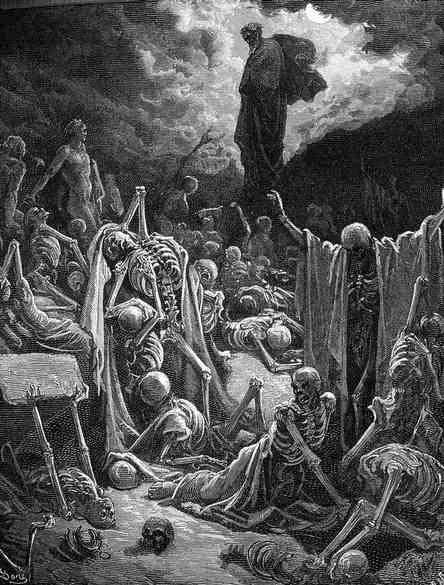
This is Gustave Dore’s Rising of the Bones (aka, Vision of the Valley of the Dry Bones, 1865, engraving), a masterwork by one of the greatest engravers and artists that I’ve yet come across.

When I started being an artist, there were certain works and creators that I was really influenced by.  Artists like Michael Whelan, and Frank Miller, and maybe none more than Dore.  Most of my first works were scratchboard or pen & ink, and to look at Dore’s works was to see everything that I wanted to do.

This particular piece is probably one of the few religious pieces you’ll get out of me (I can’t say as I’m much of a religious person), but I can’t deny Dore’s brilliance.  This scene is one of the many fantastic biblical works that Dore produced for his version of the Bible, perhaps the most sought ever version in the 19th and early 20th centuries. It depicts the prophet Ezekial from the Old Testament, as the bones reanimate back to their human form.

My favorite part of this image is that each character is seemingly unique.  There are no shortcuts here, each reanimated body brings on a life of it’s own, separate from those around it.  It’s an awakening from death, and Dore balances the horror of the idea with the sense that this is truly meant to be. He uses the light in a zig zag through the center of the piece, as if forcefully pushing aside the darkness all around.

The image really highlights all of Dore’s strengths.  There is the immense detail work that he’s known for, a great balance in the white and dark contrast of the work, and a composition that wonderfully ties it all together. Above all it’s a great story illustration, a moving piece that’s a perfect choice to accompany the work it illustrates.

Opinions?

Russ


Tags: , , , , , , , , , , ,

Powered by Wordpress
Theme adapted by Russell Dickerson from BlueMod (blueblog_DE Theme by Oliver Wunder)
Original Theme © 2005 - 2009 FrederikM.de

Switch to our mobile site