Resistance, or The Black Idol

Being an illustrator, and having been a big fan of engravings and inkwork for many years, I have a tendency to pick up on highly detailed artwork.  Since these posts are designed to help me learn how to be better at what I do (and to entertain the billions and billions of devoted followers of this blog), I thought I’d pick something different.  At least, if not different in the typical ideas that I like, different in technique or design.

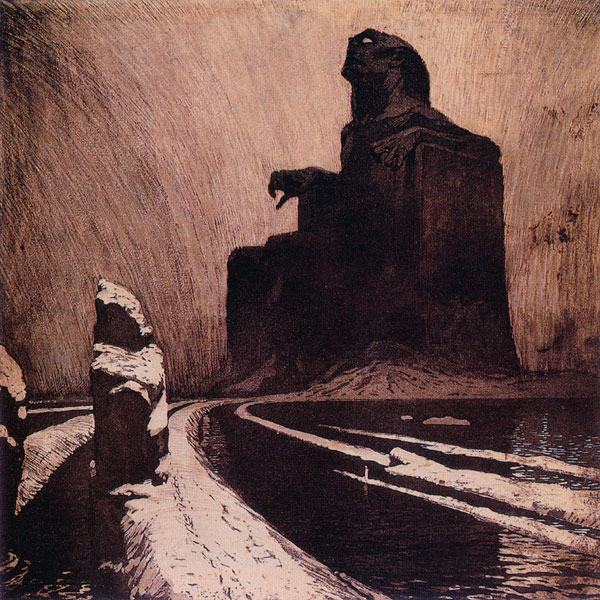
This is Frantisek Kupka’s Resistance, or The Black Idol (1903, Colored aquatint on paper, 13.7″ x 13.7″), which despite it’s fairly simplistic idea is still a striking piece.  Several of the sites that I read about it say that Coppola modeled Dracula’s castle after the piece (which I found a handful of shots of here), which certainly seems the case from the small images I’ve seen online.

I can’t spout off about color much on this one, being a mono-/duotone sort of piece.  There’s also not a huge amount of detail to talk of. No, this work is all about contrast, and using light and shadow to make your point.

Kupka uses those contrasts to great, emotional effect in the piece, and he tells his story with the simplicity of black and white.  The brightness of the lower right and across the bottom bring your eye in, right to the path leading to the statue.  At the same time, your eye is drawn by the darkness of the statue against the sky, a simple background that enhances the darkness of the statue.

Yet, the two extremes balance one another nicely.  Neither is too dominant, and they both work together to form something greater than the parts. You are drawn down the bright path right into the darkness, pulled in by the whole over the parts.

Kupka also uses several design and layout tricks to keep your eye heading where he wants it.  The angles in the art always lead you in the direction of the statue, whether that’s the angles of the path or the shadow of the smaller rock.  The linework of the sky/background curves inward towards the statue, and is darker to the outside, bringing you back to center. The curve of the path itself almost gently brings your eye to the statue, defying the horror that seemingly lays within.

The piece is really a simple one, but in that simplicity is a great power.  The lack of detail makes the image more natural, and at the same time more powerful.  Kupka’s not saying that the path is right or wrong, good or bad, only that we must take the path with him.  You can take it that you are entering into the darkness of hell, or that you are coming out of the darkness down the bright path to salvation.  As with all great works, it’s up to you to decide.

Opinions?


Tags: , , , , , , , , ,

I thought I would return to the pulp art era again, I have a wonderful book by Robert Lesser called, simply, Pulp Art, which is fantastic. I think many of the artists in the book really set the stage for illustration art ever since, and I wanted to write a few blogs about them.

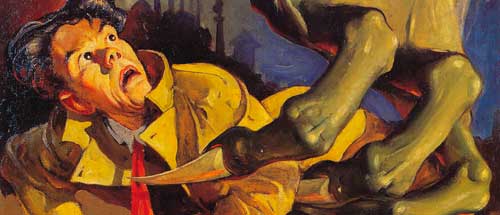
This is Edd Cartier’s cover for Unknown Fantasy Fiction, December 1939, and is a striking piece in both execution and in idea. There’s a real dramatic sense to the art, and it really would pull me in to read what’s inside.

I like Cartier’s use of color and contrast here. I think the bright yellow of the man’s jacket in the foreground fades nicely back along the green arm, back into the darkness.

There’s a real sense of depth here, and of a sense that (aside from the obvious claw) this isn’t a normal scene. Cartier uses the brightness and sharpness in the foreground to really help give us a sense of scale, letting the background blur and fade out nicely.

I like that the character’s face has a uniqueness to it as well, and that it’s not necessarily a “production” face.  You come away with the idea that this is an individual, that there’s a story here to follow. Cartier doesn’t just give us a generic victim, he gives us a unique person with a unique (although probably shortened) story.

Above all though, I just like the idea of the art and how it was executed.  I see it that this poor guy was knocked down, and was getting up in relative safety while the events in the background unfold.  As he starts to get up BAM! GIANT GREEN HAND TO MESS UP YOUR NIGHT!

That’s what I like about many of the pulp pieces, and especially this one.  There’s a story here, something that happened, or is about to happen (poor guy). If I saw this cover nowadays I would be drawn right to it, and in a cover you can’t ask for anything else.

Opinions?

ps – The image above comes from Lesser’s Pulp Art book, which is a fantastic tome on the sometimes forgotten, but brilliant art of the pulp era.  I highly suggest you pick it up, try here for starters.


Tags: , , , , , , , , , , , , ,

I think where art can be a good thing is the ability to get the feelings and emotions out on the table, without necessarily having to explain all the things you are really feeling.  I’ve always felt that art comes down more to what I want something to look like than any emotional release for myself.  But once in awhile I get into a mood where the only way to express the feelings is through art.

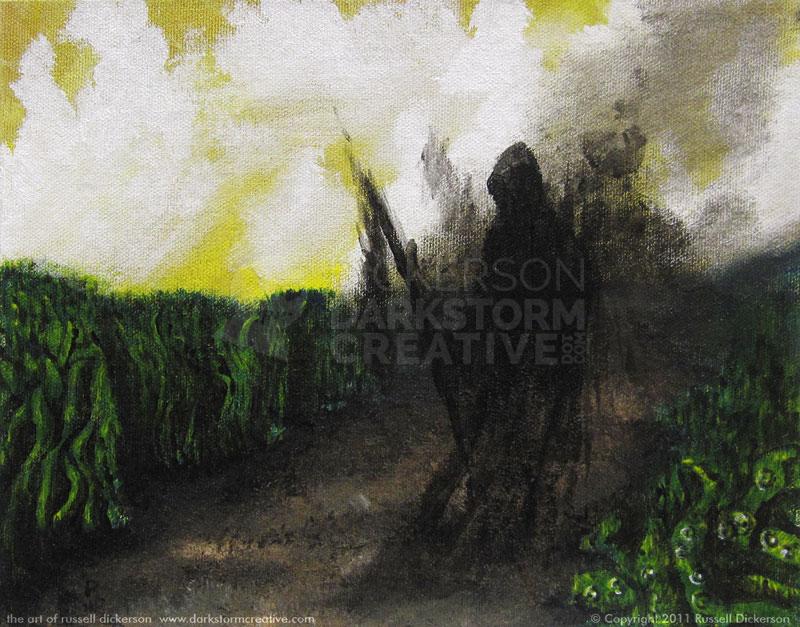
This piece here is a good example of that.  I won’t go into whatever it is that’s bothering me, you folks aren’t interested in such drivel.  It could also be that I’m looking for the road still unfound, and creating the path might be one way to find it.

Now, granted, none of the paths from this crossroad look terribly appetizing. But sometimes you just need to face the darkness, and that’s where art can come in.  Without saying anything, without going into any details, the world is laid bare for those who wish to decipher it.

That all (boringly) said, I’m also trying to sketch everyday.  This certainly counts for that, practice for the future to come.  If it’s not an emotional release, if it’s not life laid open, at the very least it’s an expression of colors and techniques that I hope one day to have mastery, or at least acceptance, over.


Tags: , , , , , , , , ,

Wrapped Masque

Sometimes you reach a point in life where the proverbial crossroads happen, and I think I’ve reached that point.  There is a definite feeling of where I’ve been, and now where I choose to go.  The paths are unclear, but there are definite choices coming.

Art.  No art.  Design. No design.  Keeping the status quo or wrecking it.  The fork in the road has been reached, and now I have some decisions to make about how life is going, and where and what I want to be doing when I type this same blog next year.

I think that’s where the above art comes from.  Earlier, I just couldn’t decide which project to get in on (except for some signing I need to do, that just requires cleaning the apartment), and I thought to myself, “just put iTunes on random and see where the art goes”.  Thus, the above piece.

I think part of where that art comes from is in one of (if not “the”) my favorite stories, The Masque of the Red Death .  I have a good idea of the visual sense of that story, and what I would do with it as an artist.  The final paragraph is always somewhere rattling around in my head too, which may explain some things about how my head works.

“And now was acknowledged the presence of the Red Death. He had come like a thief in the night. And one by one dropped the revellers in the blood-bedewed halls of their revel, and died each in the despairing posture of his fall. And the life of the ebony clock went out with that of the last of the gay. And the flames of the tripods expired. And Darkness and Decay and the Red Death held illimitable dominion over all.”

There’s a certain dark sense to the art of course (go figure), but there’s also a sense of the unknown, of things that can’t be seen and maybe shouldn’t. That’s where I’m at, at the point in the road that, even if I don’t know what lies on each path, I need to make the choice.


Tags: , , , , , , , , , , , , , , , , ,


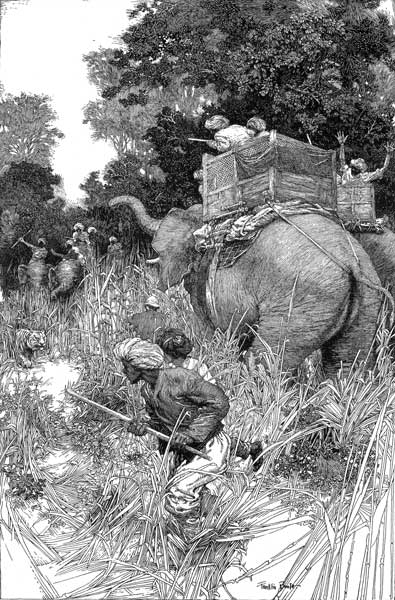
This week we’re back to a piece of art, in this case Franklin Booth’s War on the Tiger (ink, 1908). I’m a huge fan of ink and engraved works, and Booth was a master of the pen.  He is one of the most influential ink artists ever, and his techniques and styles can easily be seen among the best of today’s pen and ink artists.

I happened upon a book about Booth last week, called Franklin Booth: Painter with a Pen, and I think that’s a perfect way to describe his work.  This piece, War on the Tiger, really stood out as soon as I saw it.  It’s a great exercise for ink artists to examine, a wonderful piece that defines perfection in inkwork.

One of the toughest things about doing inkwork is the balance between the detail work and the contrast of the overall image.  Often inked works will suffer from too much detail, and the overall idea or image that was intended is lost in the process.  In this image, Booth shows how to work with the dark and light images of the overall work, and yet not lose detail where it matters.  The lightness in the lower left corner compliments the darkness of the upper right, and both converge right where the action is, at the tiger.

In fact, all of the action in this piece is aimed squarely at the tiger.  The people and animals are all pointed towards it.  The inkwork is designed to lead your eye to it.  Even the strong details and areas of light details all converge at the same spot.  This is actually where Booth succeeds, his greatest idea of all.  He’s built tension in the image, mostly in your subconscious, and his techniques give you a sense of urgency and of swift action that is difficult to pull off.

For me, again a big fan of inkwork, his draftsmanship is beautiful.  From the delicate linework in the character’s clothing, to the detailed look of the far off forest, to the intricately balanced but clean grasses in the foreground, Booth shows a masterful control of the ink and line.  That’s certainly an artist’s sight, looking at the linework and technique.  But I think Booth gives a nice, clean look to the whole piece, which anyone can appreciate over a messier, but maybe even further detailed piece.

Above all, Booth gives you a sense of the scene and of the action long before you start noticing technique.  This is a moment of truth, the men against the tiger, and within the grasses and natural environment seemingly against nature itself.  You get the excitement of the scene, the tension of the story within, and you can ask nothing more from a great artist.

Opinions?

Russ


Tags: , , , , , , , , , , , , , , , , ,

As I mentioned last week, I’m hoping to change things up a little with the art blogs, and offer more than just a “piece of the week”.  I’ll be featuring artists sometimes that you may be familiar with, if not in name than in work.

This week, I’m going to talk about Michael Deas (www.michaeldeas.com), an artist who has done some fantastic work.  Many of those in the horror community have seen his cover of Richard Matheson’s Hell House, or of one of the editions of Anne Rice’s Interview with the Vampire. Nearly everyone has seen his iconic Columbia Pictures logo as well.

Deas has been featured in many of the award compenums, including Spectrum and the Society of Illustrators.  One of my personal favorite images is the Hell House cover, which is striking.  It has a certain darkness to it that’s hard to capture, and the chills it invokes are just what an artist is looking for in such a cover.  At the same time, Deas is able to convey lightness in a work, almost an iconic imagery at times that’s truly opposite of the darkness he can also create.

His work has been featured in many different types of projects, not just in genre work. Many of his portraits can be seen on U.S. Stamps, including Hollywood stars, former presidents, historical characters and more.  He brings each character to life, seemingly not just a picture of a moment in time, but of the essence of the person.

Deas also has an eye for humor, as can be seen in some of his magazine work.  He also worked on a calendar for restaurant chain Chick-Fila, featuring “Cows in History”.

Overall, I think Deas brings a heart to his work, and offers many pieces that just need to be seen to be appreciated.

Opinions?

Russ


Tags: , , , , , , , , , , , , , , ,

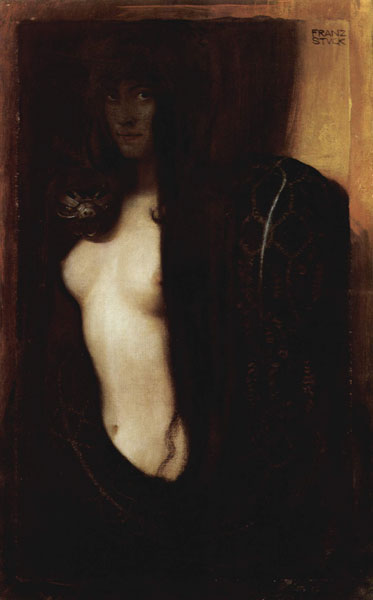
This is Franz Von Stuck’s Sin (1893, Oil on canvas, 35″ x 21″), which may get my vote for having perhaps the most accurate title of an art piece I’ve seen.

I like the color choices and palette here that Von Stuck used, or rather a lack thereof.  He keeps the colors simple, nearly a duotone.  What he does use for color throughout, due to it’s similarity, is a feeling of almost looking at the woman’s skin even when you’re not.  The colors around the outside are similar in shade and tone to the woman’s body, and it’s a temptation woven into the image. Even when you aren’t taking a look at her body, you still get the sense you’re looking into something seductive or even dark.

Von Stuck uses the composition well, though it’s a simple piece. In many pieces, the artist (any artist) would be tempted to make the woman’s head or even the snake’s head be the center of attention. The higher contrast would normally be there with the faces, and it would be set in a more accessible place.  But Von Stuck’s idea held simply to the inner thoughts of man, that when it comes to sin, you’re going to look at the body and damn the consequences.  By placing the more ominous, even the more intelligent parts, to the darkness, and highlighting so brightly the body, the viewer is led to give into the very title of the piece.

The menacing snake (the extra bright closeup to the right) would be a bit much in some scenes, but I think in this one Von Stuck did well by placing it in the shadows.  The woman’s face is still of the temptress, but the snake’s face is all about evil.

I think that in this piece, Von Stuck has done something that can be very difficult in art: to (nearly) perfectly capture a human emotion.  You (ok, mostly men here I’d bet) are drawn right to woman’s body, to the promise of lust, and to the seduction in the darkness of her face.  Von Stuck made it difficult to look away, even with the darkness and the evil so obviously present.  In that effect, he captured sin perfectly.  You know it’s wrong, but not even the snake’s going to stop you.

Opinions?

Russ


Tags: , , , , , , , , , , , , , , ,

Ok, so my “little break” was more like a couple of weeks.  Add “extreme coughing from the lungs” to “Post-Las Vegas” and there you go. But I’m back, and this one is an interesting one for me.  It’s one of the first art pieces that I really took something from, especially in the extreme emotion.

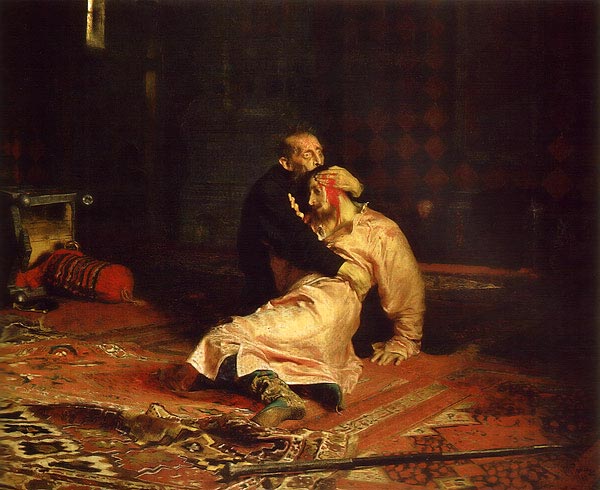
This is Il’ya Repin’s Ivan the Terrible and His Son Ivan on November 16, 1581 (1885, oil on canvas, 79″ x 100″). The artist based it on a real event, involving (natch) Ivan the Terrible.  In the heat of an argument, Ivan stuck his son with his staff, mortally wounding him.

Repin used a very nice composition here, with very little in the background to steal your attention.  The foreground is a fairly nondescript rug, with little furniture in the room either. The only furniture that you can really see is knocked over, adding to the drama of the moment.  I like is the posing of the characters too, there’s little life left in the son, but he hasn’t passed on just yet.  Ivan is holding his son tightly, and holding his hand across the wound, as if trying to hold his son here on earth as long as he can.

Along with the composition, Repin brought the contrast into only the center of the piece, leaving the rest of the image to fall off into the darkness or into similarly colored areas.  There’s a strong sense to me that the light is actually knocked over, as the shadows that are being cast seem to come from a low spot.  It adds to the drama of the scene, and to the desperation in it.

The palette of colors he uses works well, and he put it in just the right spots.  Red is quite primary in the image, but it sits mostly around the exterior of the image. It’s almost a frame of red, surrounding and even highlighting the blood on the younger Ivan’s face. Your eye is brought right to the blood in the center, and right to the shock on Ivan’s face, a face of madness and horror.

Though certainly, without an actual photograph of the event, there’s no real way to know what happened in that moment.  But Repin has captured a believable emotion perfectly, as Ivan is hit full bore with the realization that in his uncontrollable rampage he has killed his own son. Ivan’s face shows the full horror of his actions, a perfect rendition of going too far, and realizing that you can never take it back.

Opinions?

Russ


Tags: , , , , , , , , , , , , , , , ,

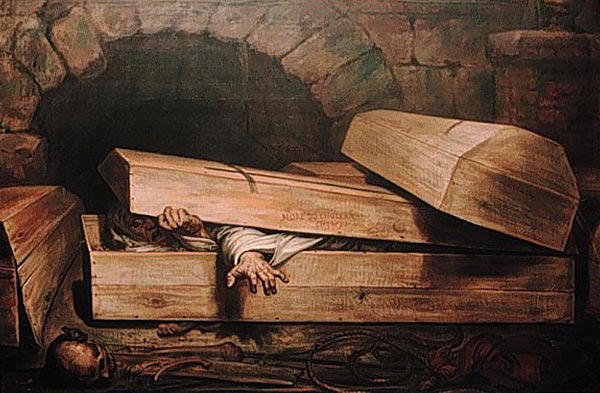
The fans of Edgar Allan Poe out there should like this one (not that they are probably reading my blog, but it’s worth a try). This is Antoine Wiertz’s The Premature Burial (1854, media/size unknown, aka The Hasty Burial), a piece I first saw many years ago accompanying Poe’s work by the same name (which was painted several years after Poe’s death).

Wiertz’s work often treaded on dark, horrific imagery, as a number of artistic and literary works of the time did.  This one actually is fairly light for him, compared to graphic images like Last Thoughts and Visions of a Decapitated Head or The Outrage of a Belgian Woman. There was quite a bit of concern in the mid-19th Century about premature burial, and this one certainly shows the horror of the event well.

In this image, the victim is a cholera victim (as evidenced by the text on the coffin) that doctors were seemingly unwilling to get close enough to really test. The content of Wiertz’s piece really shows an idea of story here, and that this person probably isn’t going to go anywhere.  The skeletons on the floor, the dilapidated coffins around him, and the coffin on top of his all give a sense of not only the terror of such a moment, but of the idea that no one is coming back to help.

Wiertz used a nice composition to highlight where your eye should be drawn.  The stone arch, the coffin on top of the victim’s, even the broken coffin to the left all lead your eye back to the man desperately trying to escape.

I also like the use of light here, and actually the lack thereof where it matters.  You are drawn to the arm coming out of the coffin, but that’s just the drama of the moment.  It’s in the subtle darkness of the rising coffin lid that the real meaning of this piece is shown.  With the most horrifying part of the image well within the darkness, the viewer’s eye is drawn into the interior of the coffin, forcing you to not just look at the horror, but to examine it thoroughly.

Of course the image reminds me of the great EC comics of the 50′s, and of much of the ideas of horror that I’ve seen in various works.  Wiertz’s powerful image is one of horror and desperation, and is a reminder that we may wake up to an unexpected horror at any time, when we least imagined it possible.

Opinions?

Russ


Tags: , , , , , , , , , , , , , , , , , , ,

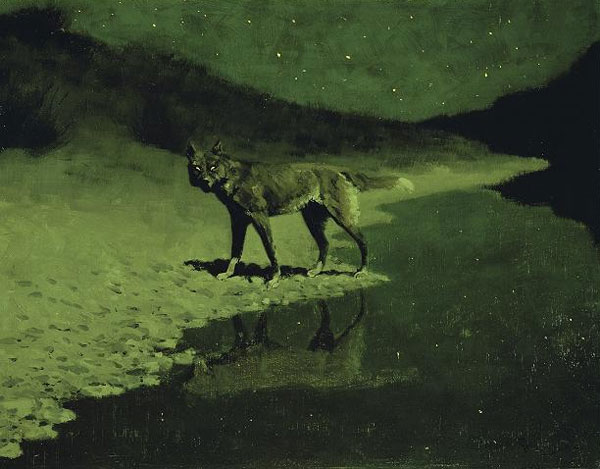
This is Frederic Remington’s Moonlight, Wolf, (1909; oil on canvas, 20 1/16 x 26 in), a bit of a different image from the typical Remington western art you’d see.

Much of the effect had to do with Remington’s life.  Many of his western works appeared before the Spanish-American War, and after he became an artist on the ground in Cuba his work took on a much darker tone.  In this image, Remington has dropped the pretense of watching the scene from the distance.  The viewer is right in the middle of things now, and in fact is in grave danger from the ominous wolf.

This is where Remington’s art had changed, and for me some of his best, most emotional works were around this time.  Remington’s earlier works were often illustrations, especially in war, where the outcome and the story are all there to follow.  But here, Remington only brings the story to us, from there we have to decide whether the wolf will have a go at us or slink away under the cover of night.

I can’t speak to the palette on this one, I found a few different versions online that were all a little different. But I think in the balance of tones he’s done very well here.  The lighter tone of the sand (or beach) follows through the center of the work, and always brings your eye back to the wolf.  The darkness is enhanced by the reflection in the wolf’s eyes, and the viewer is forced to see the power of the wolf and of the unknown in the night.

Living in the west, western artists are often put aside to specific touristy galleries.  They are often seen as only fitting a certain style, and certain topic and a certain time in history.  But I think for the really fantastic artists out there the genre is irrelevant, they are able to bring something else to the table, something extraordinary.  Remington breaks out of the western here with the dark and ominous feel of the unknown, and above all else engages the viewer, making them decide what happens next.

Opinions?

Russ


Tags: , , , , , , , , , , , , , , , ,
Pages: 1 2 Next

Powered by Wordpress
Theme adapted by Russell Dickerson from BlueMod (blueblog_DE Theme by Oliver Wunder)
Original Theme © 2005 - 2009 FrederikM.de

Switch to our mobile site