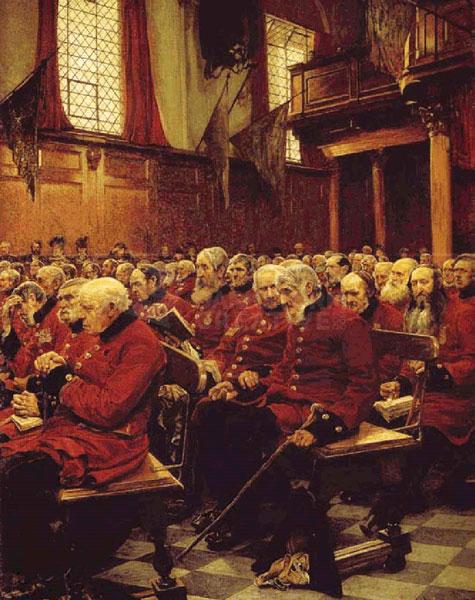
The Last Muster

I picked up James Gurney’s Imaginative Realism book last week, and I’ve been noticing certain styles that remind me of his work (see: Dinotopia).  When I saw this one, I immediately thought of the techniques that Gurney uses in much of his work.

This is Sir Hubert von Herkomer’s The Last Muster -Sunday at the Royal Hospital, Chelsea (Oil, 1875, 84.5″ x 63″), and is a great example of realism and an almost illustrative idea. In the painting (explained here), a group of elderly soldiers sit together, with little realization that one of them has died.

The man in the center of the work, with the cane and leaning over slightly, has died.  The man next to him is holding his arm (I assumed checking his pulse), with the beginnings of concern on his face.

I think what would be difficult in a scene like this is to show individuality enough that the idea that one of them has died isn’t lost. With each character needing the same outfit, with the same strong reddish tones throughout, von Herkomer has to work the composition and the individuals to show, in a subtle way, what has happened.

I think it works well for a few reasons.  First, each soldier, despite the strong similarity in age and in uniform, is given a unique feel.  Each has a different face, a certain lean, a subtlety of angle, enough that they give a sense of true group of men instead of just a background of characters.

Using composition, von Herkomer arranged the work to highlight the dead soldier as well.  He’s placed in the center of the work, with a simpler, more open area closer to the viewer. The angles of the flags and architecture above tend to point towards him as well, as well as the angle of the floor tiles. The soldiers in front and behind him are spaced further away then the rest of the group is from each other, something that catches the eye and centers it on the dead soldier.

It’s certainly a work of subtlety, and requires the viewer to really take in the whole work.  Even without being in a scene of battle, you get the sense that they lived as soldiers for their whole life. In the subtlety is a quiet story, one where, after a lifetime of discipline, their last muster must be strict and ordered as well.

Opinions?

Sir Hubert von Herkomer


Tags: , , , , ,

I’m all about cheery pics tonight, the other two I was thinking of were pretty dark too.  Something in the air maybe?

This is Jules Elie Delaunay’s Plague in Rome (1869, Oil on canvas, 52″ x 69″), also known as The Angel of Death. I might be wrong, but this isn’t the happiest of images I’ve done with these art blogs. It is, however, one of those pieces that seems to be at odds with itself.

Let’s start with the visual sense of it, especially in the contrast.  The image is virtually split in half, between the light and the dark areas of the work. In this version (originally from the Musee d’Orsay), which is brighter than some of the others online (such as here), the balance isn’t quite as obvious.  But it is apparent that the angels (both good and bad, seemingly) are in a far brighter area than the rest.

Delauney uses both the palette and the composition to enhance the angels. The left half of the image (and to some extent the lower right corner) has very subdued tones, and very crowded figures.  The angels are much brighter, both in color and in tone, and are in a simpler, more open area of the image.  Your eye is drawn to them, but you still examine the horrors of the plague in the darkness nearby.

The angels perfectly demonstrate the dynamic, almost paradoxical nature of the image.  The brightness of the angel in flight, the “glory of god” come to save man.  In contrast, the dark angel banging on the door, as if bringing death to all.  But in their motions, the flying angel seems to be directing the dark one, ordering him to be death whether he likes it or not.

That’s where this painting starts to take on a new life.  Are the angels good, removing the horror of the plague from the house within?  Are they bringing light to such a dark, horrible time?  Or is it the opposite, have they come to bring death to all?  Are they angrily attacking, demanding to put a stop to the horrors at all costs?

The victims and others in the scene are almost torn in what they want.  Some are fighting death, some seem horrified by the angels, and some are even indifferent. It’s as if the others in the scene are just as taken aback by the angels as we are.

This is what I love about the best pieces in art.  Sometimes a fairly accepted image of angels, one that’s easily passed off as religious art, brings up far more ideas than originally expected.  The Plague of Rome challenges the ideas of good and evil, pagans and religion, and even destiny.

Opinions?


Tags: , , , ,

Ok, so it’s been a little while since the last one of these art blogs. I’ll see if I can’t post a few more of them, and without the 4 months between them.

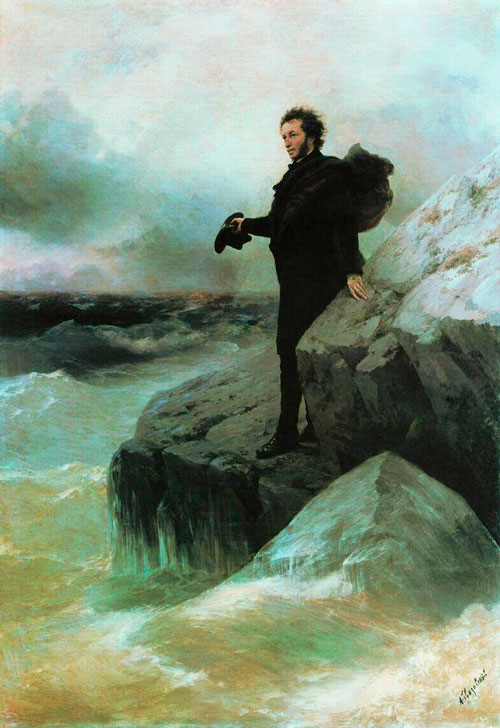
Above is Ivan Aivazovsky and Ilya Repin’s Pushkin’s Farewell to the Sea (1887, Oil on canvas), one that caught my eye when I was looking for the new piece.  Probably because it reminds me a bit of one of my favorite pieces, Caspar David Friedrich’s Wanderer Above a Sea of Mist (here).

I’ll be the first to admit that I don’t know a great deal about Alexander Pushkin, the man in the piece. I know that he was a great Russian poet, and lived a wilder life similar to Byron.  Unfortunately, other than that, I’m light on information.

I think though that this piece can stand without the knowledge of who Pushkin was, and the life that he led.  It stands on it’s own, both as a indication of Pushkin’s life and as a simpler story of a man at the crossroads.

First, on the composition and palette.  I think that Aivazovsky and Repin (who I’ve talked about before) have a great sense of what they want to accomplish together. You don’t get the sense that Repin worked on the man, and Aivazovsky the landscape (which is how it was according to several sites), but that the piece is of a common hand.

The darkness of Pushkin’s clothes bring you right to him, with the lighter shades of the sky, the darker ocean and the angle of the rocks all bringing you back to him. What’s interesting (and well done) is how Aivazovsky and Repin frame the darker colors within the light, and also, in return, the light shades of Pushkin’s face within. It brings you right to the emotional spot in the piece, but doesn’t force you there as the neutral tones of the overall piece soften the blow.

What I like to is the emotion of Pushkin, the ambiguity of his look and feel. He’s not neutral in his emotion, but his portrayal can be seen in different ways.  Is saying a sad, forlorn goodbye to what he loves? Is it a sarcastic goodbye, to follow a new path? Is it an unsure step? Aivazovsky and Repin leave that to the viewer, a way to involve the user in the painting and not simply show you a scene.

Aivazovsky and Repin give you a sense that Pushkin, having come down to the rough sea on the rough rocks, has lived an untamed, wild life. Yet, in Pushkin’s calmness to the scene we see that he’s already lived that life, and he’s deciding where it goes from here.

The viewer too is left with an inquisitive sense of it all too, to explore where Pushkin has been and where he’s going.  That’s what a great piece of art can do, to inspire those who see it to make their own path.

Opinions?


Tags: , , , ,

My daughter and I were lucky enough to visit the Denver Art Museum over last weekend, and I came away (as I often do) with a number of new favorite works.  What I like about visiting a museum is not only getting a more personal feel of the artworks, but I come upon new styles and new pieces all the time.

Now, I’m an illustrator of course, so I’m drawn to other illustrators and illustrative works.  It’s no strange thing then that the piece above caught my eye at the museum, as it is by one of the great illustrators of the twentieth century.

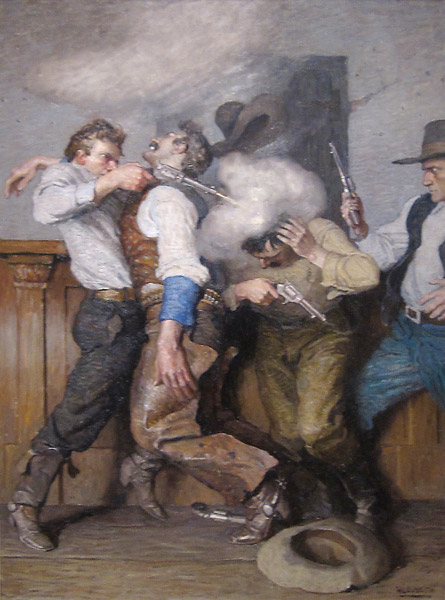
This is N.C. Wyeth’s Gunfight (1916. Oil on canvas, 34″ x 25″), a piece that really caught my eye when we were going through the museum. I’ve seen a number of Wyeth pieces in museums now (including the Benjamin Franklin work at the Amon Carter Museum in Texas), and I always have to stop and look at them.

One thing I’ve read while getting information on Gunfight is that Wyeth’s work here seems staged, as if it’s in a play.  That’s not unusual for Wyeth as far as I can tell, I’ve seen quite a number of his works that seem to have that feeling.

For me though, I don’t really consider that a bad thing.  I see it more as Wyeth’s composition technique, using the more plain or set background with the complexity in front of it to give the viewer a faster, easier sense of what is happening in the scene.  As Wyeth’s works often accompanied a story, it’s a fine balance that the artist has to deal with.  The illustration adds depth to the story and gives a better understanding of what’s going on, but it also can’t interfere too much lest the reader stop reading along.

It’s a little harder to tell in my decently fuzzy picture above (I couldn’t find a larger one, though the intent is all there), but Wyeth uses a nice contrast and color palette in the work. The blues and brighter white areas bring your eye right to the action, and add to the overall sense of excitement in the otherwise drab palette of the background.

It’s definitely an action piece, more “pulp” than what would normally be considered fine art.  It’s a romanticized, almost staged battle, but that doesn’t throw off the effect at all.  It brings you into the fight, into the adventure, and does what a good illustration ought to do.  It makes you want to finish the story, and find out what happened once and for all.

Opinions?


Tags: , , , , , , , ,

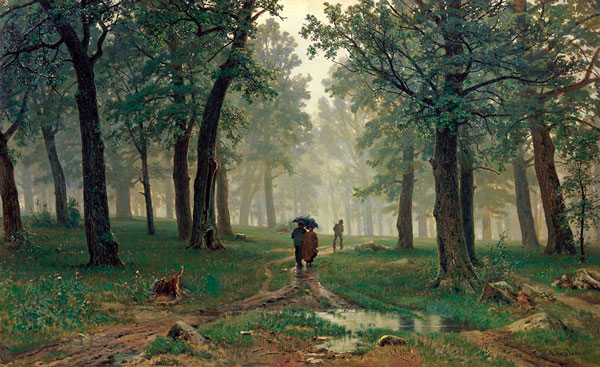
I was actually doing some searching for a few pieces by Vasily Vereshchagin (who I’ve blogged about before), and I decided to look around a bit at some of the other Russian artists.  I came across the piece above, Rain in the Oak Grove by Ivan Shishkin (Oil, 1891), and I knew I’d found a new piece to talk about.

In the day and age of the Thomas Kinkades of the world, it bears remembering that the techniques and ideas of those “modern” landscapes are based fully on those that came before.  In most cases (watch out! opinions!) the paintings of the past are far more interesting than the “kinkade” effect of the last decade.

Here is a piece that’s nearly one hundred and twenty years old, but has so much more emotion to it than many similar landscapes of the current age.  There’s a palpable sense of being there that Shishkin brings to the piece, and you can easily imagine yourself here, in the forest, wandering quietly behind the other group.

The composition breaks one of the big cardinal rules that you often hear, to stay out of the center of the piece.  The idea is that keeping the interesting part of the image in the center makes it less interesting, less dramatic.  But I think Shishkin made up for it by keeping the overall image in thirds, and by having the center be so much more inviting. The path, the leaning of the trees, even the leaning of the characters (namely the front runner) all give you a strong sense of direction, as if taking you by the hand and leading you through the forest.

I like the color palette here as well, especially as the piece is about being in the rain.  There is a sense of bright colors, and a brighter sky, but there’s also a sense that the color is being gently subdued by the rain.  Shishkin really gives a sense that you are in a rainy forest, and the color choices help to quietly nuance the effect.

For me, Shishkin really captures what it’s like to be in nature here.  It’s a scene that’s neither too light or too dark, too happy or too sad, or simply too much.  Shishkin created an enticing, real-world feeling, where nature isn’t good or bad, but just is. He’s leading you down a nice, gentle path in the rain, and it’s easy enough to follow him.

Opinions?


Tags: , , , , , , , , , , ,

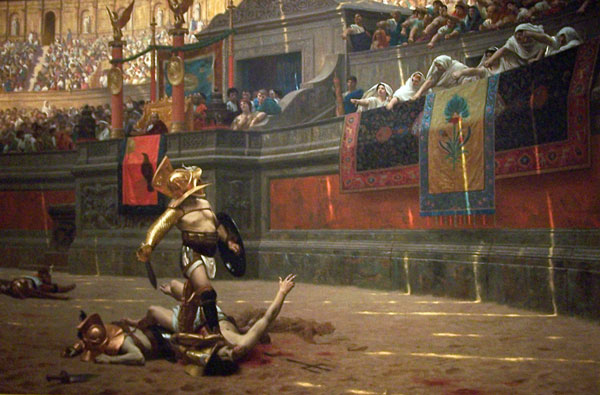
I don’t get to art museums and galleries enough, but it can really give you a different impression of a piece of art.  In this case, last week I was at the Phoenix Art Museum and saw the piece here, Pollice Verso (Thumbs Down) by Jean Leon Gerome (oil, 1872, 38″ x 59″).

First off, I do like the piece overall.  I think it has a good use of color, a very nice balance in composition and a good use of the light and dark shades to create a good contrast.  But I’ve always been a big fan of really detailed paintings, and this one offers that up by the boatload.  Even with the smaller image above of the full version, you can see where Gerome spent alot of time creating a detailed, realistic scene.

In real life, in the art museum, you get to appreciate that detail far more than you can in a small 600 pixel wide image on the screen, or even a 4 inch wide version in a book.  When you can stand in front of a piece that’s almost five feet across in front of you, you can see details that you could never see in the book.

At the bottom of the page here I’ve tried to give you an idea of some of the details you miss normally.  You see the intricate design of the victor’s arm mesh.  You see the representative designs on the gladiators’ helmets, very difficult to see in the full image onscreen.  You can see the humanity in the crowd, the the lack thereof of those who deciding the fate of those in the arena.  You also get to see history, and not just what’s represented.

When you are at a museum looking at a piece, more often than not you can literally put your nose inches away from the painting.  You get to see the age in the painting, the cracks that are obvious in the coppery helmet of the man on the ground, and those less obvious on his skin.

You can also see the artist’s individual, painstaking brushstrokes, and you realize that he stood in front of this very painting 136 years ago and put that brush on the canvas. The curve of the paint swath, the gentle rise and fall of the texture in the paint still visible after a century, and then you see history itself, alive right in front of you, you see that it’s not just a picture, but something a person laid to canvas in another time.

Opinions?

Russ


Tags: , , , , , , , , , , , , , , , ,

After a busy (and depressing) holiday season, I’m attempting to restart the art blog idea.  This time though, I’m going to work things a little differently. Instead of just a piece of art each week, I’m going to alternate on artistic ideas.  Some weeks will still be about a certain piece, other weeks about artists or books/graphic novels, and other various art-related themes.  Hopefully people will still tune in.

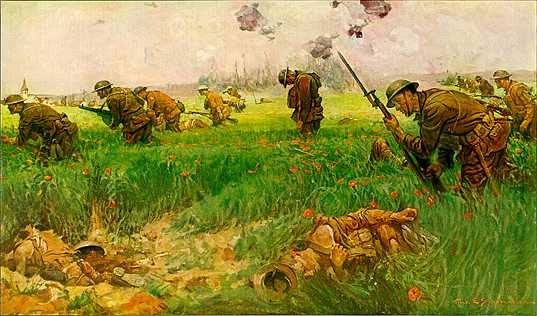
For the first of the new year, I’m talking about Frank E. Schoonover’s “Assault on Belleau Wood“, also known as “How Twenty Marines Took Bouresches” (oil, early 20th century). Schoonover was one of the great illustrators of the early 20th century, a student and friend of Howard Pyle.

In this piece, Schoonover shows a battle from World War I (information on the battle can be seen at http://www.worldwar1.com/dbc/ct_bw2eng.htm), and also showcases his wonderful abilities at realism and storytelling. There is a sense of action and tension in the art, as if we are seeing a certain moment in the story. The men all seem to be waiting for the next shot, the one that might have their name on it.

Schoonover does however give the scene almost a moment of pause to reflect on the dead at the front of the scene.  The body towards the left seems to have been there before, but the one in the foreground (right) seems to have just fallen, as indicated by the man directly above him.  Schoonover has succeeded in giving us a realistic moment of time, and includes the complexity that a real moment would have.

I like the composition of this piece quite a bit, I think Schoonover really draws in the story with it.  The open area between the lines of men is almost the line between life and death. The open, lighter area gives way to the dark figure in the center, one that we assume is either hanging on or has died right as the moment happened. The composition also curves in all respects towards the left, as if saying that the men are all moving forward, regardless of what’s about to happen.

I can’t speak to the color too much unfortunately, there are several versions online and the colors are slightly different in each.  In each though (especially in this version) there seems to be a brightness to the grasses and flowers, to me saying that horror and darkness can invade anywhere.  Even in the beauty of nature, the darkness of war can come.

Opinions?

Russ


Tags: , , , , , , , , , , , , ,

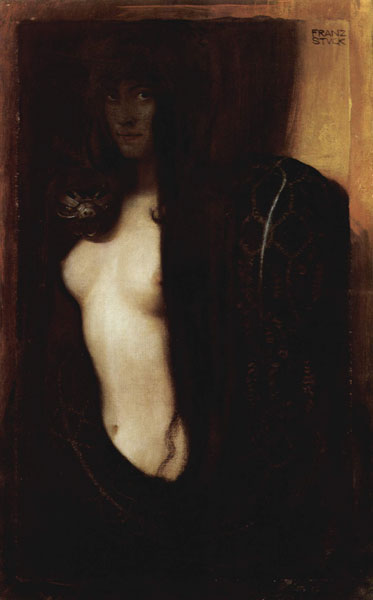
This is Franz Von Stuck’s Sin (1893, Oil on canvas, 35″ x 21″), which may get my vote for having perhaps the most accurate title of an art piece I’ve seen.

I like the color choices and palette here that Von Stuck used, or rather a lack thereof.  He keeps the colors simple, nearly a duotone.  What he does use for color throughout, due to it’s similarity, is a feeling of almost looking at the woman’s skin even when you’re not.  The colors around the outside are similar in shade and tone to the woman’s body, and it’s a temptation woven into the image. Even when you aren’t taking a look at her body, you still get the sense you’re looking into something seductive or even dark.

Von Stuck uses the composition well, though it’s a simple piece. In many pieces, the artist (any artist) would be tempted to make the woman’s head or even the snake’s head be the center of attention. The higher contrast would normally be there with the faces, and it would be set in a more accessible place.  But Von Stuck’s idea held simply to the inner thoughts of man, that when it comes to sin, you’re going to look at the body and damn the consequences.  By placing the more ominous, even the more intelligent parts, to the darkness, and highlighting so brightly the body, the viewer is led to give into the very title of the piece.

The menacing snake (the extra bright closeup to the right) would be a bit much in some scenes, but I think in this one Von Stuck did well by placing it in the shadows.  The woman’s face is still of the temptress, but the snake’s face is all about evil.

I think that in this piece, Von Stuck has done something that can be very difficult in art: to (nearly) perfectly capture a human emotion.  You (ok, mostly men here I’d bet) are drawn right to woman’s body, to the promise of lust, and to the seduction in the darkness of her face.  Von Stuck made it difficult to look away, even with the darkness and the evil so obviously present.  In that effect, he captured sin perfectly.  You know it’s wrong, but not even the snake’s going to stop you.

Opinions?

Russ


Tags: , , , , , , , , , , , , , , ,

Ok, so my “little break” was more like a couple of weeks.  Add “extreme coughing from the lungs” to “Post-Las Vegas” and there you go. But I’m back, and this one is an interesting one for me.  It’s one of the first art pieces that I really took something from, especially in the extreme emotion.

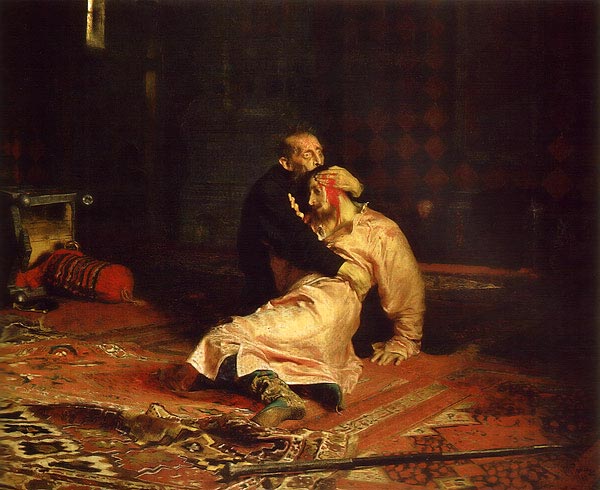
This is Il’ya Repin’s Ivan the Terrible and His Son Ivan on November 16, 1581 (1885, oil on canvas, 79″ x 100″). The artist based it on a real event, involving (natch) Ivan the Terrible.  In the heat of an argument, Ivan stuck his son with his staff, mortally wounding him.

Repin used a very nice composition here, with very little in the background to steal your attention.  The foreground is a fairly nondescript rug, with little furniture in the room either. The only furniture that you can really see is knocked over, adding to the drama of the moment.  I like is the posing of the characters too, there’s little life left in the son, but he hasn’t passed on just yet.  Ivan is holding his son tightly, and holding his hand across the wound, as if trying to hold his son here on earth as long as he can.

Along with the composition, Repin brought the contrast into only the center of the piece, leaving the rest of the image to fall off into the darkness or into similarly colored areas.  There’s a strong sense to me that the light is actually knocked over, as the shadows that are being cast seem to come from a low spot.  It adds to the drama of the scene, and to the desperation in it.

The palette of colors he uses works well, and he put it in just the right spots.  Red is quite primary in the image, but it sits mostly around the exterior of the image. It’s almost a frame of red, surrounding and even highlighting the blood on the younger Ivan’s face. Your eye is brought right to the blood in the center, and right to the shock on Ivan’s face, a face of madness and horror.

Though certainly, without an actual photograph of the event, there’s no real way to know what happened in that moment.  But Repin has captured a believable emotion perfectly, as Ivan is hit full bore with the realization that in his uncontrollable rampage he has killed his own son. Ivan’s face shows the full horror of his actions, a perfect rendition of going too far, and realizing that you can never take it back.

Opinions?

Russ


Tags: , , , , , , , , , , , , , , , ,

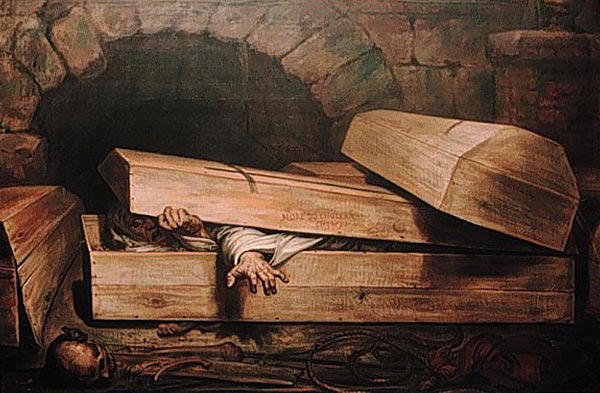
The fans of Edgar Allan Poe out there should like this one (not that they are probably reading my blog, but it’s worth a try). This is Antoine Wiertz’s The Premature Burial (1854, media/size unknown, aka The Hasty Burial), a piece I first saw many years ago accompanying Poe’s work by the same name (which was painted several years after Poe’s death).

Wiertz’s work often treaded on dark, horrific imagery, as a number of artistic and literary works of the time did.  This one actually is fairly light for him, compared to graphic images like Last Thoughts and Visions of a Decapitated Head or The Outrage of a Belgian Woman. There was quite a bit of concern in the mid-19th Century about premature burial, and this one certainly shows the horror of the event well.

In this image, the victim is a cholera victim (as evidenced by the text on the coffin) that doctors were seemingly unwilling to get close enough to really test. The content of Wiertz’s piece really shows an idea of story here, and that this person probably isn’t going to go anywhere.  The skeletons on the floor, the dilapidated coffins around him, and the coffin on top of his all give a sense of not only the terror of such a moment, but of the idea that no one is coming back to help.

Wiertz used a nice composition to highlight where your eye should be drawn.  The stone arch, the coffin on top of the victim’s, even the broken coffin to the left all lead your eye back to the man desperately trying to escape.

I also like the use of light here, and actually the lack thereof where it matters.  You are drawn to the arm coming out of the coffin, but that’s just the drama of the moment.  It’s in the subtle darkness of the rising coffin lid that the real meaning of this piece is shown.  With the most horrifying part of the image well within the darkness, the viewer’s eye is drawn into the interior of the coffin, forcing you to not just look at the horror, but to examine it thoroughly.

Of course the image reminds me of the great EC comics of the 50′s, and of much of the ideas of horror that I’ve seen in various works.  Wiertz’s powerful image is one of horror and desperation, and is a reminder that we may wake up to an unexpected horror at any time, when we least imagined it possible.

Opinions?

Russ


Tags: , , , , , , , , , , , , , , , , , , ,
Pages: 1 2 Next

Powered by Wordpress
Theme adapted by Russell Dickerson from BlueMod (blueblog_DE Theme by Oliver Wunder)
Original Theme © 2005 - 2009 FrederikM.de

Switch to our mobile site