I’m in the middle of moving this month to a new house (yay me!), complete with an office (and a door), so these posts are a little spotty.  But I’ll try and keep up with them.

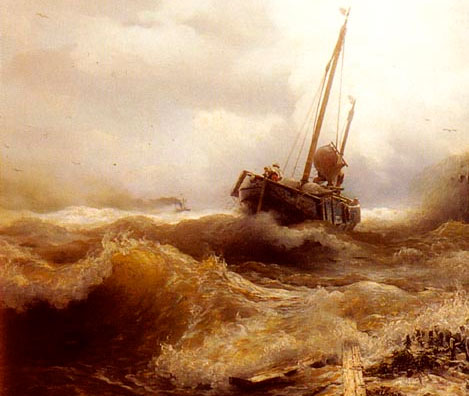
The above work is Andreas Achenbach’s A Fishing Boat Caught In A Squall Off A Jetty (1865, oil on canvas, 38″ x 55″), a piece that caught my attention when I was looking for the last art blog piece.  It’s a very dramatic piece, something I’m always apt to appreciate.

I think this piece grabs me for a few reasons.  First off, the color palette.  With photography, I’m a big fan of sepia tones.  It gives you an older, almost worn look that smacks of age.  I think the sepia palette here definitely works in its favor, giving not only a sense of age but that this was an entirely different era.  You get the sense that Achenbach captured a real moment, a real-life drama played out right in front of the artist.

There’s a strong sense in the work of nature vs. humanity, and it gives it a sharp dramatic sense.  The smooth lines of the man-made structures give way to the randomness of the waves and the sky. Each side seems almost to be taunting the other, and we’re not sure if man will have his dock or if it will all be swept away.

For me, that’s the strongest point of the work.  This isn’t just a wave coming in, or the rising tide.  The water is alive, and is fighting everything in its path. Not just the boat, but the people and maybe even the dock itself don’t seem to stand a chance against the violent waves.

Some of my favorite artists and works offer a glimpse of a different world, or different time.  Some of them make nature seem alive, and in some cases threatening.  I think this piece captures all of that.  Nature is rushing ashore with unstoppable power, and pity anything that stands in its way.

Opinions?


Tags: , , , , , , , ,

My daughter and I were lucky enough to visit the Denver Art Museum over last weekend, and I came away (as I often do) with a number of new favorite works.  What I like about visiting a museum is not only getting a more personal feel of the artworks, but I come upon new styles and new pieces all the time.

Now, I’m an illustrator of course, so I’m drawn to other illustrators and illustrative works.  It’s no strange thing then that the piece above caught my eye at the museum, as it is by one of the great illustrators of the twentieth century.

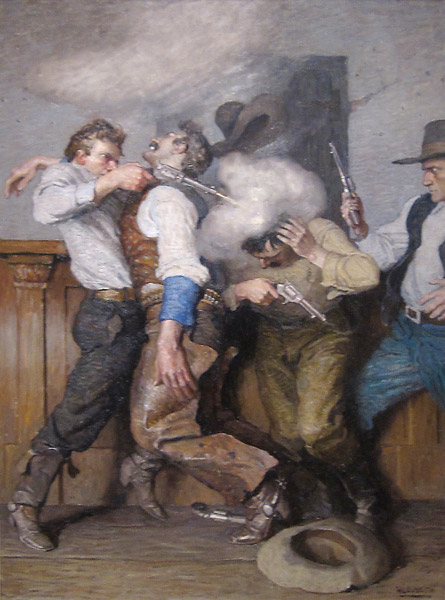
This is N.C. Wyeth’s Gunfight (1916. Oil on canvas, 34″ x 25″), a piece that really caught my eye when we were going through the museum. I’ve seen a number of Wyeth pieces in museums now (including the Benjamin Franklin work at the Amon Carter Museum in Texas), and I always have to stop and look at them.

One thing I’ve read while getting information on Gunfight is that Wyeth’s work here seems staged, as if it’s in a play.  That’s not unusual for Wyeth as far as I can tell, I’ve seen quite a number of his works that seem to have that feeling.

For me though, I don’t really consider that a bad thing.  I see it more as Wyeth’s composition technique, using the more plain or set background with the complexity in front of it to give the viewer a faster, easier sense of what is happening in the scene.  As Wyeth’s works often accompanied a story, it’s a fine balance that the artist has to deal with.  The illustration adds depth to the story and gives a better understanding of what’s going on, but it also can’t interfere too much lest the reader stop reading along.

It’s a little harder to tell in my decently fuzzy picture above (I couldn’t find a larger one, though the intent is all there), but Wyeth uses a nice contrast and color palette in the work. The blues and brighter white areas bring your eye right to the action, and add to the overall sense of excitement in the otherwise drab palette of the background.

It’s definitely an action piece, more “pulp” than what would normally be considered fine art.  It’s a romanticized, almost staged battle, but that doesn’t throw off the effect at all.  It brings you into the fight, into the adventure, and does what a good illustration ought to do.  It makes you want to finish the story, and find out what happened once and for all.

Opinions?


Tags: , , , , , , , ,

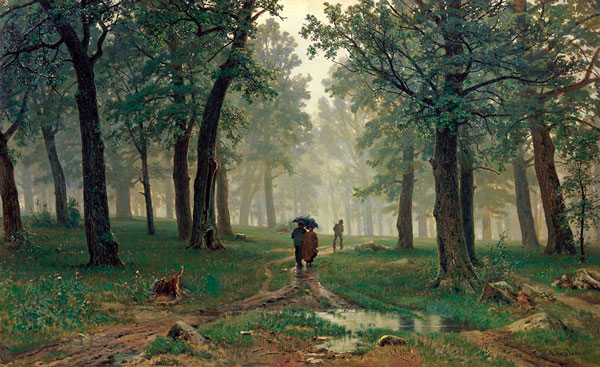
I was actually doing some searching for a few pieces by Vasily Vereshchagin (who I’ve blogged about before), and I decided to look around a bit at some of the other Russian artists.  I came across the piece above, Rain in the Oak Grove by Ivan Shishkin (Oil, 1891), and I knew I’d found a new piece to talk about.

In the day and age of the Thomas Kinkades of the world, it bears remembering that the techniques and ideas of those “modern” landscapes are based fully on those that came before.  In most cases (watch out! opinions!) the paintings of the past are far more interesting than the “kinkade” effect of the last decade.

Here is a piece that’s nearly one hundred and twenty years old, but has so much more emotion to it than many similar landscapes of the current age.  There’s a palpable sense of being there that Shishkin brings to the piece, and you can easily imagine yourself here, in the forest, wandering quietly behind the other group.

The composition breaks one of the big cardinal rules that you often hear, to stay out of the center of the piece.  The idea is that keeping the interesting part of the image in the center makes it less interesting, less dramatic.  But I think Shishkin made up for it by keeping the overall image in thirds, and by having the center be so much more inviting. The path, the leaning of the trees, even the leaning of the characters (namely the front runner) all give you a strong sense of direction, as if taking you by the hand and leading you through the forest.

I like the color palette here as well, especially as the piece is about being in the rain.  There is a sense of bright colors, and a brighter sky, but there’s also a sense that the color is being gently subdued by the rain.  Shishkin really gives a sense that you are in a rainy forest, and the color choices help to quietly nuance the effect.

For me, Shishkin really captures what it’s like to be in nature here.  It’s a scene that’s neither too light or too dark, too happy or too sad, or simply too much.  Shishkin created an enticing, real-world feeling, where nature isn’t good or bad, but just is. He’s leading you down a nice, gentle path in the rain, and it’s easy enough to follow him.

Opinions?


Tags: , , , , , , , , , , ,


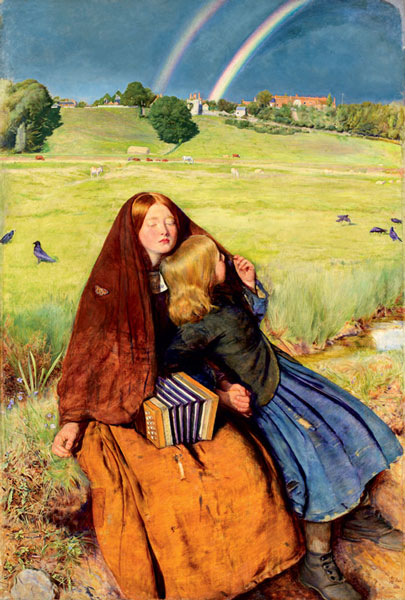
We’re back on a single piece of art this week (since I couldn’t decide on a different topic), this time it’s John Everett Millais’ The Blind Girl (Oil on canvas, 1854-1856, 32 1/2″ x 24 1/2″). It’s one of those pieces where the title really does impact what you see in the image, or at least makes it clear.

It’s an image of duality, of great beauty but of disturbing meaning.  A first glance is a visual feast, showing the beauty of nature, the unusual double rainbow that’s hard to come by in real life, and even the beautiful butterfly on the girl’s shoulder.  But it’s there that you start to realize that the girl in the orange dress can, cruelly, never enjoy the beauty around her. She is blind, and will never know the wonder that it around her. Even the smaller girl in her lap is a cruel twist, as she is fascinated by the environment, alone in her wonder.

Millais really uses a nice color palette and the contrast of the art to set a gorgeous scene.  Bright blue skies, ever flowing fields of green, even the brighter (if worn) blue dress of the smaller girl give such a bright sense to the art that you can’t help but think of a perfect day.  Even the blind girl’s dress is a soft shade of orange, almost teasing her with the brightness she will never see.

For me, Millais’ work always has wonderful detail work, and usually in natural settings. This one is no different, as Millais offers not only great details in the foreground, but a nice, even detail through the background as well. It’s not overpowering, but gives a sense of reality to the work.  What works best is that Millais knew where to soften that detail, knowing that the lack of details in the right areas will enhance the piece.

What I like most in the piece is just the idea that a second look at it, with more information, really sets it apart.  Many might just walk right on by it, noting the beauty of it and moving along.  It’s only on further thought, on further knowledge, that we find out that sometimes even the most beautiful things can really be dark.

Opinions?

Russ


Tags: , , , , , , , , , , , , , , , , , ,

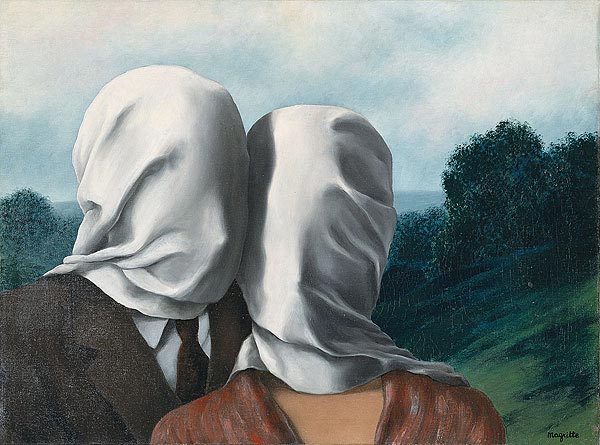
Here’s another of the images that I posted on the Message Board of the Damned so long ago.  This is Rene Magritte’s The Lovers (1928, oil, 21″ x 29″, aka Les Amants), a piece which I’ve had ready to post for some time, but decided to hold onto. It’s just such an interesting, disturbing piece (maybe) that I had to finally write about it (well, again).

Magritte’s image is probably one of the most open to interpretation that I’ve ever seen.  It can really be taken in just about any context, and the experiences of the viewer play a great part in that.  Think about it for a second.  Take a good, long look at the art.  Once you’ve had your good long look, close your eyes and imagine the art again, and imagine what just happened before the scene and after.

I’ll give you a moment.

I’ll bet that the ideas you had in your head are fairly different from mine, and from everyone else’s.  Magritte’s magic here is that the meaning behind the image is completely left up to us, and whether those ideas are light, have meaning, or are even dark.  Are the lovers just goofing around in front of the camera?  Is it a message about anonymity?  Are these lovers about to be pushed off the train, and this is their last goodbye?  It’s a fantastic work of the idea and of the content of the piece to keep everyone seeing their own stories.

What Magritte did beautifully too was to keep it simple.  The color palette is subdued, so no one color is distracting.  The detail is kept simple, even the background could be anywhere at nearly anytime. It’s level on the contrast, even the highlights on the shrouds aren’t fully white. Magritte made sure that none of the other elements of the art were distracting, they all work together so smoothly.

Magritte often had unusual, strange visions in his art.  He created ideas and worlds that were odd, and yet somehow approachable.  The Lovers is a great example of that, a work that anyone can make up their own mind on themselves.  Is it dark?  Is there a message? Is it all in fun?

It’s all up to you.

Opinions?

Russ


Tags: , , , , , , , , , , , , , , ,

Death

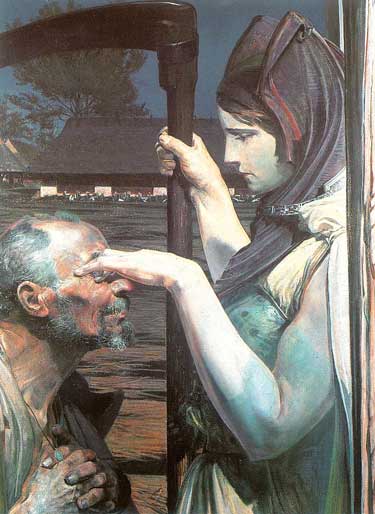
This is Jacek Malczewski’s Death (1902, Oil on panel), and if you were a visitor to the former Message Boards of the Damned you may recognize this piece.  It’s one of my personal favorites, filled with everything that makes a piece of art great.

Malczewski is an important artist in Europe especially, a Polish artist who was very influential.  Many of his works mix history with legend and mythology, and nearly all of his works were symbolic in some way.

I like the color palette that he chooses to use in Death.  The bluish-grayish colors in the work add a different dimension to it, almost as if saying that the man is already dead and this is just formality.  The use of bluish color on the woman, as opposed to the skin color used on the man, really indicates that she is otherworldly, and there is no life there.  The subtlety in using just a hint of the blue in the man’s skin is wonderful, the hint in color a useful hint to the man’s status.

Subtlety is this work’s strongest suit, and in an image where other artists may have boldly declared, “death is here!”, Malczewski plays it quietly. Death herself, though heavily symbolized in the scythe, seems powerful yet gentle, and almost sad in her understanding of her duty. The man seems to understand how things are himself, he is seemingly relieved and also happy to go to heaven.  He clutches his necklace tightly, believing his faith is about to save him as opposed to the darkness that other artists might’ve shown.

This is one of those pieces that I see that is immensely inspirational to my own work.  Malczewski’s use of color, tone and the subject of his work are all fantastic, and it’s a striking image that sticks with you for much longer than just a quick viewing.  It’s an exercise in mixing reality with the fantastic, a great piece of art.

Opinions?


Tags: , , , , , , , , , , , , , ,

Powered by Wordpress
Theme adapted by Russell Dickerson from BlueMod (blueblog_DE Theme by Oliver Wunder)
Original Theme © 2005 - 2009 FrederikM.de

Switch to our mobile site