I thought I would return to the pulp art era again, I have a wonderful book by Robert Lesser called, simply, Pulp Art, which is fantastic. I think many of the artists in the book really set the stage for illustration art ever since, and I wanted to write a few blogs about them.

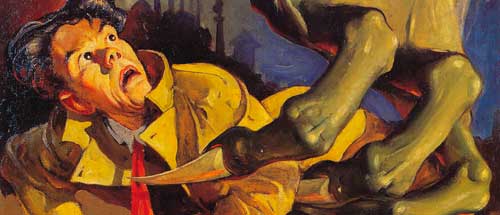
This is Edd Cartier’s cover for Unknown Fantasy Fiction, December 1939, and is a striking piece in both execution and in idea. There’s a real dramatic sense to the art, and it really would pull me in to read what’s inside.

I like Cartier’s use of color and contrast here. I think the bright yellow of the man’s jacket in the foreground fades nicely back along the green arm, back into the darkness.

There’s a real sense of depth here, and of a sense that (aside from the obvious claw) this isn’t a normal scene. Cartier uses the brightness and sharpness in the foreground to really help give us a sense of scale, letting the background blur and fade out nicely.

I like that the character’s face has a uniqueness to it as well, and that it’s not necessarily a “production” face.  You come away with the idea that this is an individual, that there’s a story here to follow. Cartier doesn’t just give us a generic victim, he gives us a unique person with a unique (although probably shortened) story.

Above all though, I just like the idea of the art and how it was executed.  I see it that this poor guy was knocked down, and was getting up in relative safety while the events in the background unfold.  As he starts to get up BAM! GIANT GREEN HAND TO MESS UP YOUR NIGHT!

That’s what I like about many of the pulp pieces, and especially this one.  There’s a story here, something that happened, or is about to happen (poor guy). If I saw this cover nowadays I would be drawn right to it, and in a cover you can’t ask for anything else.

Opinions?

ps – The image above comes from Lesser’s Pulp Art book, which is a fantastic tome on the sometimes forgotten, but brilliant art of the pulp era.  I highly suggest you pick it up, try here for starters.


Tags: , , , , , , , , , , , , ,

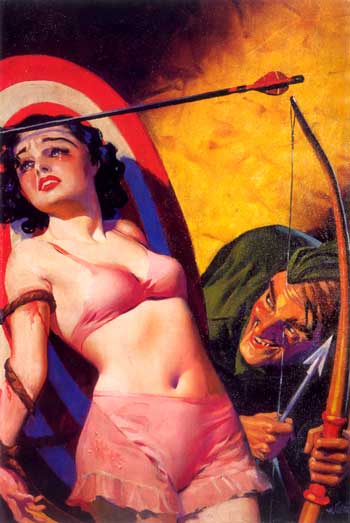
Last year sometime (maybe even the year before, the last few have been a blur) I picked up a fantastic oversized book called Pulp Art ($12.95 no less!). The image above is from the book, it’s a cover of Spicy Mystery Stories Magazine (oil?, 1936) by pulp artist H.J. Ward.

This pulp image in many ways seems like alot of the others that existed at the time.  A dark villain, a dastardly deed, a gorgeous woman in peril, all the makings of the pulp art of the 20th century.  But this one for me stands out, and there’s alot of things that point to a more thought out approach to art that Ward used.

The pulp artists, of course, were illustrating story images, so the covers often showed a part of a story in progress.  In this image, I think Ward captured a great moment in time.  It reminds me of Edward Hopper’s work, where we get to see that something’s about to happen or it just did.  With Ward’s shot here, we get to see that something already happened, and something worse is about too. A nice moment of tension to draw the viewer (and the buyer) in.

The Pulp Art book has a nice “conversation” on the following page to this, and it makes alot of good points on what Ward really did here.  It’s obvious that it shows a heightened sexuality present in the 30′s pulp art covers, but here there’s more to it.  Before the time seen here, this woman has already been through alot.  An arrow almost in the head stands out, but if you look closer (the book points this out, so I can’t take the credit) at her arm you’ll notice something subtle, but disturbing. Her arm is at an awkward angle, and in fact her wrist is already broken.  The “posed” woman from the pulp covers now has real emotion, a broken woman who may get something even worse very soon.

I like how Ward used the layout to his advantage as well, as each object or design we see forces the eye right where he wants it.  The orange/yellow background is a slice of light, bringing your eye through the evil and into the desperate woman.  Angles help in art to allow the viewer visual cues to where they really should be looking, a technique that’s very valuable in comics.  In this cover, Ward uses the technique perfectly, moving the eye where needed without forcing you harshly, allowing you to see for yourself.

I think Ward’s colors and tonal balance are great too.  The colors pop off the page, something important for a book cover.  No one’s going to buy a bland, tonally boring piece of art, and the same thing happens to an extent with books.  If the cover jumps off the shelf at you, especially in a huge pile of other pulp novels, it’s going to get recognized.

The pulp artists are often forgotten in today’s world, and that’s unfortunate.  Underneath the rough and tumble, highly sexualized stories, there was a chance to bring powerful illustrative art to the forefront.  The pulp artists laid the groundwork for the fantasy artists of the rest of the century and beyond, and I think Ward’s cover here is a perfect example of the best in pulp art.

Opinions?

Russ


Tags: , , , , , , , , , , , , , , ,

Powered by Wordpress
Theme adapted by Russell Dickerson from BlueMod (blueblog_DE Theme by Oliver Wunder)
Original Theme © 2005 - 2009 FrederikM.de

Switch to our mobile site