After talking about it for the last couple of years, my son finally committed to being Colonel America for Halloween.  For those who haven’t read it (and are still reading my blogs), Colonel America is a version of Captain America from the comic series Marvel Zombies. This was all his idea too.

Here, ladies and gentlemen, is the 12 year-old Halloween version:

We have the cheap Walmart Captain America outfit (sans muscles), a cheap mask from Savers, a “brain” mold for gelatin, and a few other minor parts and makeup. Other than the shield, which, although not really cheap per se ($25), will be on my office wall by the morning. That part’s more of a long term keeper, and the mask probably (which is on a styrofoam mannequin head right now.

Here’s a close up of the head… eww…

and just a good overall shot of it, goryness and all:

I think it worked out well, and he was very happy with it.  At the end, I had him pose next to the book itself as a comparison.  Not too bad…


Tags: , , , ,

The Last Muster

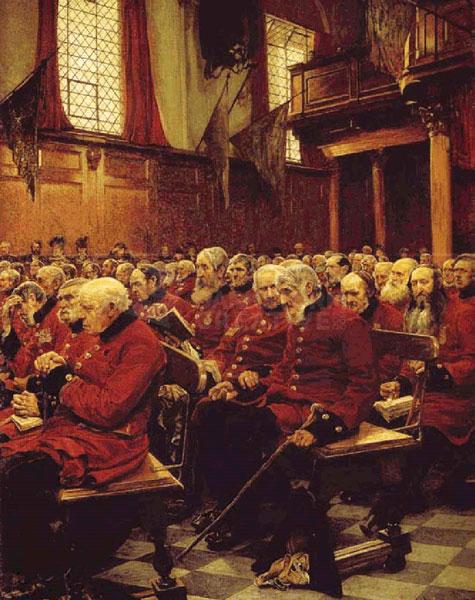
I picked up James Gurney’s Imaginative Realism book last week, and I’ve been noticing certain styles that remind me of his work (see: Dinotopia).  When I saw this one, I immediately thought of the techniques that Gurney uses in much of his work.

This is Sir Hubert von Herkomer’s The Last Muster -Sunday at the Royal Hospital, Chelsea (Oil, 1875, 84.5″ x 63″), and is a great example of realism and an almost illustrative idea. In the painting (explained here), a group of elderly soldiers sit together, with little realization that one of them has died.

The man in the center of the work, with the cane and leaning over slightly, has died.  The man next to him is holding his arm (I assumed checking his pulse), with the beginnings of concern on his face.

I think what would be difficult in a scene like this is to show individuality enough that the idea that one of them has died isn’t lost. With each character needing the same outfit, with the same strong reddish tones throughout, von Herkomer has to work the composition and the individuals to show, in a subtle way, what has happened.

I think it works well for a few reasons.  First, each soldier, despite the strong similarity in age and in uniform, is given a unique feel.  Each has a different face, a certain lean, a subtlety of angle, enough that they give a sense of true group of men instead of just a background of characters.

Using composition, von Herkomer arranged the work to highlight the dead soldier as well.  He’s placed in the center of the work, with a simpler, more open area closer to the viewer. The angles of the flags and architecture above tend to point towards him as well, as well as the angle of the floor tiles. The soldiers in front and behind him are spaced further away then the rest of the group is from each other, something that catches the eye and centers it on the dead soldier.

It’s certainly a work of subtlety, and requires the viewer to really take in the whole work.  Even without being in a scene of battle, you get the sense that they lived as soldiers for their whole life. In the subtlety is a quiet story, one where, after a lifetime of discipline, their last muster must be strict and ordered as well.

Opinions?

Sir Hubert von Herkomer


Tags: , , , , ,

It’s that itch to create, sometimes I just can’t shake it.  After a long month of trying to face all my feelings after the accident, I just needed to sit down and do some art for myself.

I do have a few projects waiting in the wings, and they are fantastic projects.  But for some reason, my mind’s just been dragged down in the last month.  I kept trying to concentrate on projects, but I just couldn’t find the muse.  So, I thought, I just need to sit down and do it.

I think as an artist, when you hit one of those blocks, you just need to let it go and start creating.  It doesn’t have to have direction, or a specific idea, or even be finalized in the end.  You just need to create, and let those demons work themselves out.

In this case, I had a completely different idea going in on what I wanted to do.  But I kept that nagging voice quiet, and just let the art lead me where it wanted to.  The result is the piece below, as always let me know what you think.

I call it, “Deathly Reflection”, and if you want a wallpaper of it for your computer download that here.


Tags: , , , , ,

After a bit of discussion earlier today on Twitter with photographer, author and all around nice guy John Urbancik, I decided to write a quick blog on how I would approach a problem in Photoshop.  In this case, scratches.

Now, there are untold types of scratches, so I won’t go into too far really.  In this case, I’m showing a couple of methods of “scratching” someone’s skin.  In this case… ahem… mine.

I took a photo of my hand (to which my little girl without missing a beat, says, “why are you doing that? Can I do that too? What about a leg?”, and so on. Here’s the unadulterated pic of that, and, for this demonstration, a texture image of a tree.

Now, before I get too far ahead of myself, there are billions (and billions and buuulllions) of ways to do this very same thing, this is just one way.  As my friend says, your mileage may vary.

In Photoshop, I take the tree bark photo and drag it into the hand photo.  It doesn’t have to be tree bark, really any texture that has or can be made to be narrow and thin will work.  Grass, tree bark, house siding, celery, whatever texture you want your scratches to have.  In this case, the bark is too “fat”, too wide to convincingly be made to look like scratches.  So we squish it a bit, and then rotate it to match the angle of the hand.

You have to think of this as a story almost.  You can’t just throw any texture at it, it will be obvious to everyone that it’s manipulated. You have to toy with the angle a bit to match your object, in this case I’ve turned the texture a bit to match.  You may also need to go further, such as skewing it, or distorting one corner, or even using Photoshop’s Liquify filter to help it match some.

You don’t need to spend hours getting that angle perfect, you’ll probably end up needing to tweak it a bit later on anyway.  As long as it’s pretty close, you’re fine.  To help the texture work with the tones, shadows and texture of the hand, you can manipulate Photoshop’s Layer Blending Modes to get what you want.  Now, each blending mode has a specific effect, but to be honest I tend to just cycle through them until I see what I like. In this case, I’m leaving it (for now) on “Vivid Light”.

At that point, add a layer mask to the tree bark layer and start working out how your scratches are going to work.  You can erase it instead, but then if you want to edit the effect, or expand on it, it’s much harder to pull off.  Using a layer mask, you can work over the bark until it matches your idea of scratches.  Just make sure you don’t leave any hard edges.  This is an organic item, so a flat edge in it is a dead giveaway.

It’s quite a bit different now, and far more striking.  It’s also wrong.  As you can see, the location and the angle are wrong, but again, that’s why you don’t spend all that time above.  Just fix it up a bit, not only making sure that the angle is right, but that the texture isn’t awkwardly crossing a fold or other skin anomaly.

Scratches can of course cross a fold in real life, but they wouldn’t be constant through the gap. There would be a section of skin missed, so you either account for that in the image or you move the scratch so it doesn’t interfere.

The other thing to watch out for is obvious digital editing.  Whenever you edit a texture or layer, there’s a chance you’ll leave part of it behind (like a ghost). Even if those ghosts are really tiny in the picture, the human eye will notice something is wrong.  The best way to get rid of those while you are freehand painting the mask is to just make your brush size smaller and smaller.  Not too small though, or you’ll get an obvious hard edge.

After you work with it a little more, you can come out with a nice set of scratches:

Now, I don’t mind that color, but I’m thinking something a little more interesting, possibly even more subtle, would be nice.  After a little more mask manipulation, a change to the “Color Burn” Layer Blending Mode, and a slight blur on the bark’s mask, I have this:

Which to me looks much more painful, and in fact I keep looking at my hand to see if it’s still ok.  It is the witching season after all, and maybe I cursed myself.  I’ll be back in a minute, I’m going to go look for some peroxide.

Oops.. too late.

One quick note: you can easily have the scratches be brush strokes on their own layer.  Depending on the texture you’re going for (skin, wood, metal, etc.) you can paint it and then mess with the blending modes.

One other quick note: another way is to use a harder edged brush on a new layer, and set the layer style to “bevel and emboss”.  Then you can literally paint on a 3D-ish scratch around the edge of something. Especially for metal or wood, or something with “rough parts” coming off of the scratch, that would work well.


Tags: , , , , , , ,

It’s definitely possible that this image has the longest title of any that I’ve done so far, and undoubtedly will take me several Tweets to promote. That won’t be confusing at all, but then again, I suppose you are actually here.

I’ve been thinking of trying out one of Howard Pyle’s works for some time, but they’re kind of difficult to come by online.  For someone of Pyle’s stature, having taught, been friends with and overall influencing at least a couple of generations of artists, that’s a big surprise.

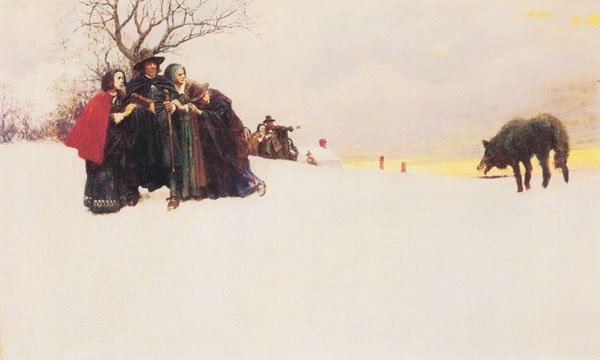
A Wolf Had Not Been Seen in Salem for Thirty Years (above, from 1909) struck me as a fascinating piece as soon as I saw it. There are quite a few of Pyle’s works that I find interesting, and this one certainly stands out. For me, it stands out because of the many things Pyle doesn’t do here.
There are plenty of Pyle’s works that are more aggressive, more forward in either their content or in the pure visual setting of the pieces.  Do a search for Attack on the Chew House or even his far more famous work The Nation Makers to see images that are very strong, practically dripping with emotion and strength.

Pyle seemed to have been split between works that are highly engaging, full of energy and action, and works that are quiet, subtle, and speak in a low volume. Having been an illustrator for some time, that certainly makes sense, as the art is driven by the story and thus, drives the portfolio as well.

A Wolf Had Not Been Seen in Salem for Thirty Years falls definitely into the latter camp. It’s far more subtle, far quieter within the image itself.  But I think that’s deceptive.  Laid within the quiet confines of this image is a violent trap just waiting to be sprung.

Pyle’s image is rather sparse, between the snow and the cloudy sky he leaves the viewer’s eye to latch onto the people and the wolf. Your eye falls upon the people in the front, and the mix of fear and of the unknown is very strong here. Pyle creates his people, the landscape and even the tree with a sense of direction, all bringing your eye to the wolf.

Illustrators can really vary as to how they’d deal with a creature like the wolf.  But I think no amount of gore, or bared teeth or monstrous form are going to top Pyle’s wolf.  This is a creature of pure malevolence, and in Pyle’s subtlety he’s speaks volumes.

He doesn’t need the over-the-top horror to make a striking figure.  Just the wolf’s bowed head, his menacing lean forward, his matted, dark fur against the white of the snow, all make it such a powerful darkness invading the light that the viewer can fill in the story themselves.

Pyle here does what any good, creepy horror movie or scary book can do.  It’s not about showing everything, not about explaining every detail. It’s the terrible, quiet invasion by a creature of the dark, evil come to the light.

Opinions?


Tags: , ,

There are all sorts of stories and blogs out there about doing art from nature, learning landscapes, all that kind of thing, so I’ll do my best not to bore you to tears.

Yes, I’ll wait patiently here while you’re out.

Hello?  Anyone?

So the two of you that are left reading this, I’ll say that there is plenty to learn from in nature.  There are so many textures, views, styles and all kinds of visuals that an artist can easily spend a lifetime learning just the natural side of art. Case in point, a simple trip to the local pumpkin patch can be a huge boon to the imagination.

So we’re looking through the squash, gourds, vines, pumpkins and all the other plant life, and we find sort of the typical lineup of a pumpkin patch:

Everything normal, except for the ZOMBIE SQUASH GETTING READY TO EAT THE OTHERS!*

Up to this point, I thought just the oddly shaped gourds you find in the pumpkin patch, with their twisted fins and designs, were about as weird as they get. Note exhibit A, especially the green funky one at the top:

Unusual?  Sure, at least for city boys like me. But it’s not ZOMBIE SQUASH™!

That thing is just terrible looking, all gnarled and wrinkled and textured. I think it started crawling towards me too:

Then it turned over and went back the other way:

After it ate one of the kids, it finally occurred to me that this is exactly what nature can do.  Nature (and let’s not forget the farming involved in this too) created this unique, textured and thoroughly inspirational piece for me to work with.  It fires the imagination to think of all of the things this could be, and then hurrying on to write stories, or paint pictures or make movies or whatever it will be that inspires you.

Is it a crawling zombie worm?  Is it an alien larvae? Did someone leave an apple in the sauna?  With a quick flash of nature, and the sense to open up your eyes and look at all that’s around you, you can be inspired to create things that are unique to you, and to your vision.

For me, I saw this:

and immediately saw in my head the terrifying creature coming from the heavens, a violent, tortured look on it’s face, to destroy us all.

Awesome.

*Note: It’s actually a Blue Hubbard Squash, but I like ZOMBIE SQUASH™ better.


Tags: , , , ,

Powered by Wordpress
Theme adapted by Russell Dickerson from BlueMod (blueblog_DE Theme by Oliver Wunder)
Original Theme © 2005 - 2009 FrederikM.de

Switch to our mobile site