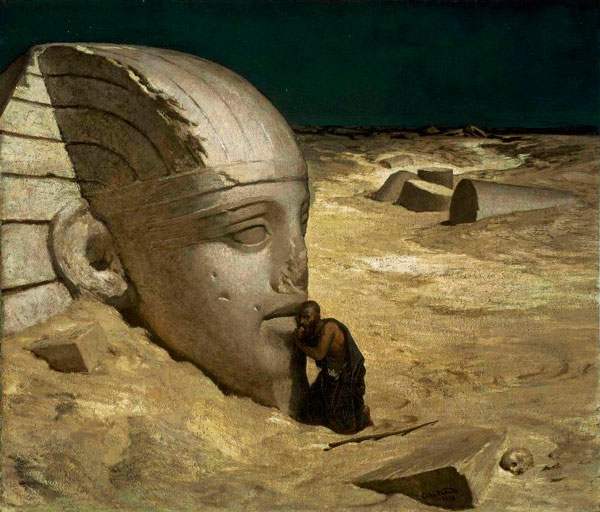
I’ve run across a number of Elihu Vedder’s pieces before, and this one is one of my favorites.  This is Vedder’s, The Questioner of the Sphinx (1863, oil on canvas, 36″ x 42″), and is a piece that for me is always inspiring.

The idea of the riddle of the sphinx is ancient, and at the time this was painted the fascination of ancient cultures and especially the Egyptians was in full swing. What I like about this piece is the setting.  Not that images of Egypt (or the sphinx) are unusual by any means (See: The Mummy), but the ruins buried in a never-ending sandy landscape make it more interesting, and more mysterious.

Vedder used the darkness of the image to a dramatic effect, isolating his main character.  He keeps the details to the edges and into the middle, and the barren landscape, punctuated only by the ruins, helps to further isolate the lone traveler.

I think Vedder’s palette works well here, though I have see slightly different versions online with other colors.  This seems to be the most consistent, and in all of the versions none of the color is too bright.  Vedder uses the earthy midtones, in a way that actually subdues the drama of the moment.  But it is the marriage of scene, detail and those tones that work together to increase the drama of the moment, despite no one feature being dominant.

For me, as an illustrator, I love a piece that tells a story.  This one certainly does, and leaves much to the viewer’s imagination.  The traveler seems to have come a long way, almost desperate to find any answer to his important questions.  Another had apparently been here before to ask questions, with seemingly bad results.

Vedder’s piece brings us to a desolate realm, to a desperate scene. Nature, or possibly the magic of the sphinx, now owns this realm.  Will he get his answers?  Will he even be able to ask the questions?

That, as in many great works of art, is up to us.

Opinions?


Tags: , , , , , , , ,

I thought this week I’d take a look at a simpler piece, and see it from a different light.  In the case of Bierstadt, I’ve honestly seen others that I like a little better, but I still like this one too.  It also makes a good point on how seeing in up close in the museum can give you a different feel for it.

This is Albert Bierstadt’s Wind River Country (1860, oil on canvas), which I recently saw at the Denver Museum of Art (fancy that, that’s where that earlier Wyeth was from…).  I’ve seen many Bierstadt works in art books (and a handful in person), and I think he had a real knack for capturing the feel of the wild.  Many of his scenes were painted far later than when he was actually onsite, which led to some interesting “imaginings” of what was really there.  But I don’t think what he added and adjusted took away from the intent at all, and you are still drawn to the wide open spaces and the beautiful lands.

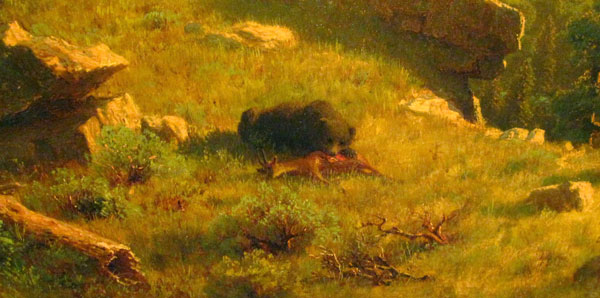
What you don’t get from a little three inch wide image (probably grayscale at that) in an art book is the detail that Bierstadt painted into his scenes.  For instance, when you see it up close, you get this below:

What was just a lump of dark in the the smaller image gives way to the full scene, of nature at its’ wildest. You get a sense from the smaller images of Bierstadt’s work (including the one at top) that he liked to add detail.  But when you are standing in front of it, when you see the immense detail and thought that he put into the work, you realize that this isn’t just another landscape work.  This is capturing nature at a moment in time, at a feeling of the wild, of nature at its’ most sacred.

Now, this painting is maybe 3-4 feet wide (can’t find it online, and the little girl wouldn’t stand in front of it for scale), and yet Bierstadt not only painted the detailed mountains, skies and landscape before you, but he included so many minor details in it that you get the feeling that he must’ve had a camera ready (though he didn’t, just lots of test sketches).

What I take away from the work is twofold.  First, seeing a work in person at the museum (or wherever it might be) just gives you a different sense that a little shot in a book.  Sure, you might really like the overall piece, but this image proves that sometimes the “devil is in the details”.

Lastly, I think Bierstadt is not just showing the pretty pictures, but trying to convey a way of life.  Like a fantasy world, or a city street view, or even a haunted house, artists are always trying to give you sense that you are in a new place, somewhere you haven’t been before and maybe aren’t used to.  The best artists can give you a scene that gives you a different reality to ponder, and Bierstadt here gives you one of natural, wild beauty untouched by man.  In the details he shows you that even in the beauty of nature, you have to watch your step.

Opinions?


Tags: , , , , , ,

Years ago, when dinosaurs ruled the earth and I was but a young punk, I went to college to be a civil engineer.  The reasons I’m not now an engineer are for a later time, but I’ve never lost my love for beautiful architecture.

In the late 90′s and early oughts’, I dabbled in the idea of producing simple architectural design prints.  Other than the one and only print of the Villa Rotunda that my friend has, there have only been smaller versions on this site in my somewhat neglected design pages.

Below are a few samples, as always feel free to let me know what you think.  It might be something I try again, maybe large works in pen and ink or something instead of the vector graphics these are.

————————

————————

————————


Tags: , , , , ,

Powered by Wordpress
Theme adapted by Russell Dickerson from BlueMod (blueblog_DE Theme by Oliver Wunder)
Original Theme © 2005 - 2009 FrederikM.de

Switch to our mobile site