I’ve been picking away at a color sketch in Photoshop, and I think it’s finally done.  I try to do pencil sketching, ink and crosshatching practice and Photoshop/digital sketching and manipulation each week just to get new ideas rolling around in my head.  Sometimes they work, other times not so much.

I’m also trying to get something down on paper (or on “monitor”) when I think about it.  I have a few sketchpads, and I have a new Moleskine that I’m trying out.  Along with that, if I see a picture that I’ve taken I’ve been trying to practice with it and go with whatever flow comes along.

The piece below is one of those.  You’ll notice on a previous blog I talked about the skull/anatomical reference I built (you do read all of these things right?), and I grabbed one of those pics and manipulated it.  I have a hard time calling such work “art”, I think I lean towards calling them “photo illustrations”.

Let me know what you think of it. I call it Gods in the Depths Below.


Tags: , , , ,

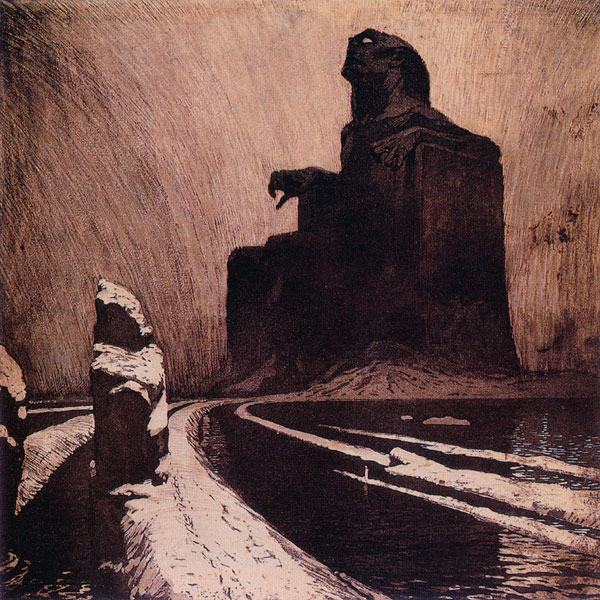
Resistance, or The Black Idol

Being an illustrator, and having been a big fan of engravings and inkwork for many years, I have a tendency to pick up on highly detailed artwork.  Since these posts are designed to help me learn how to be better at what I do (and to entertain the billions and billions of devoted followers of this blog), I thought I’d pick something different.  At least, if not different in the typical ideas that I like, different in technique or design.

This is Frantisek Kupka’s Resistance, or The Black Idol (1903, Colored aquatint on paper, 13.7″ x 13.7″), which despite it’s fairly simplistic idea is still a striking piece.  Several of the sites that I read about it say that Coppola modeled Dracula’s castle after the piece (which I found a handful of shots of here), which certainly seems the case from the small images I’ve seen online.

I can’t spout off about color much on this one, being a mono-/duotone sort of piece.  There’s also not a huge amount of detail to talk of. No, this work is all about contrast, and using light and shadow to make your point.

Kupka uses those contrasts to great, emotional effect in the piece, and he tells his story with the simplicity of black and white.  The brightness of the lower right and across the bottom bring your eye in, right to the path leading to the statue.  At the same time, your eye is drawn by the darkness of the statue against the sky, a simple background that enhances the darkness of the statue.

Yet, the two extremes balance one another nicely.  Neither is too dominant, and they both work together to form something greater than the parts. You are drawn down the bright path right into the darkness, pulled in by the whole over the parts.

Kupka also uses several design and layout tricks to keep your eye heading where he wants it.  The angles in the art always lead you in the direction of the statue, whether that’s the angles of the path or the shadow of the smaller rock.  The linework of the sky/background curves inward towards the statue, and is darker to the outside, bringing you back to center. The curve of the path itself almost gently brings your eye to the statue, defying the horror that seemingly lays within.

The piece is really a simple one, but in that simplicity is a great power.  The lack of detail makes the image more natural, and at the same time more powerful.  Kupka’s not saying that the path is right or wrong, good or bad, only that we must take the path with him.  You can take it that you are entering into the darkness of hell, or that you are coming out of the darkness down the bright path to salvation.  As with all great works, it’s up to you to decide.

Opinions?


Tags: , , , , , , , , ,

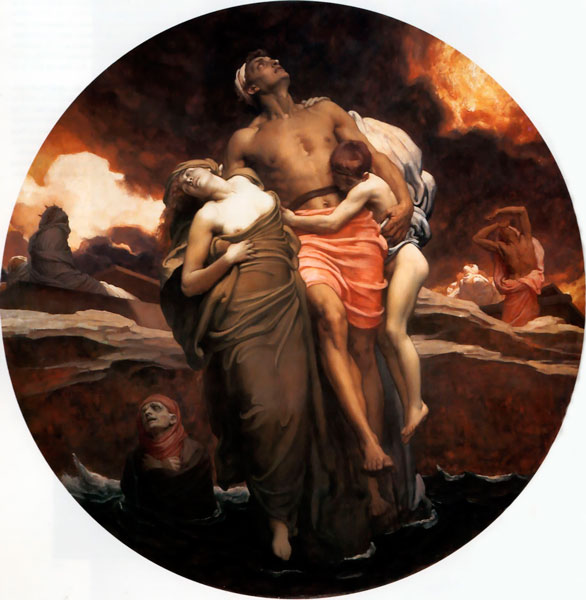
This is Lord Frederick Leighton’s And the sea gave up the dead which were in it (1891, oil on canvas, 90″, much larger link here), a piece that caught my eye when I was looking for something else (which is often the case).

I don’t tend to do biblical pieces all that often, mostly because I’m not a religious person, but also because there tends to be a more structured, more “official” look to many of them.  Now, before both of you (or am I down to one person reading these now) let me have it, I just tend to think that the non-religious art pieces are a little more open, the artist seeming a little more free to do as they wish.  As my friend says though, your mileage may vary.

Leighton has created a large image at 90″ across, which I’ve read was originally intended as ceiling art in St. Paul’s Cathedral (see here for reference). The size and dramatic sense of the piece certainly makes sense then, as does of course the content.  The image shows the last judgment, and is based on Revelations (20th chapter).

Before I say what I think on the content, let’s talk about the artistry.  I like Leighton’s use of color and contrast here.  The colors are all fairly subdued, yet certainly help bring your eye into the work.  You are first drawn to the man in the center (partially because, well, he’s in the center), something that’s helped by his red clothing.  Leighton also uses a fiery palette in other parts, a sense that something otherworldly is happening.

Leighton’s use of contrasts works very well here, and really helps tell the story.  The bright white of the woman’s chest keeps your eye in the center of the work (and not at her body, that’s not what I mean– well maybe some), but the the bright clouds behind her also give a sense of the earth to the image.  At the same time, the midtones of the piece keep your eye from straying too far off the mark, and drives home further impact to the events at hand.

Where I think Leighton worked best was actually in using that contrast and the gray levels to give an idea of what’s happening in the scene. The man in the center, and a number of the people around him are seemingly grayed out, more subtle than the others. The man’s wife in his arm, the boy and even a few of the characters in the back are far brighter, which to me seems to indicate what happened during the judgment, and the final act now in progress.

Along with the bright characters, the characters all seem to indicate, by body language and facial expression, different ideas.  The man in the center, the man on the right and even the darkened woman in the foreground all seem to be worried or anguished, where there’s a sense of relaxation, even rapture in the others.

The piece itself is nicely open to interpretation. To me, Leighton is showing that, as the dead rise again, they are being sent to their final places.  Some to rest, others to damnation.  What strikes me as the pinnacle of the piece is the boy.  I take it that, based on his contrast and color, that he’s rising to heaven.  He’s holding onto his father tightly, not wanting to let him go.  He knows his father isn’t joining them, and it’s his last goodbye as he ascends to heaven.

Opinions?


Tags: , , , , , , ,

I’ve been trying to improve as an artist, through a number of different means.  One of those is simply trying new ideas, one of which I came across on the Computer Graphic Society’s website (in this case, forums.cgsociety.org).  In the “Artistic Anatomy and Figurative Art” forum there is a thread where you get two weeks to create whatever the topic is, and then get feedback (which is the great part) from other artists on there (who themselves have added their own pieces).

The topic a few weeks ago was “Post-Apocalyptic Survival Bunny”, which I thought sounded like a lot of fun. The topics are completely open-ended, it’s up to each artist to interpret each idea in their own unique way, so I did.

Here’s the image that I came up with, by all means let me know what you think of it. I think I’ll call it, “Rabbitfield”.


Tags: , , , , ,

My daughter and I were lucky enough to visit the Denver Art Museum over last weekend, and I came away (as I often do) with a number of new favorite works.  What I like about visiting a museum is not only getting a more personal feel of the artworks, but I come upon new styles and new pieces all the time.

Now, I’m an illustrator of course, so I’m drawn to other illustrators and illustrative works.  It’s no strange thing then that the piece above caught my eye at the museum, as it is by one of the great illustrators of the twentieth century.

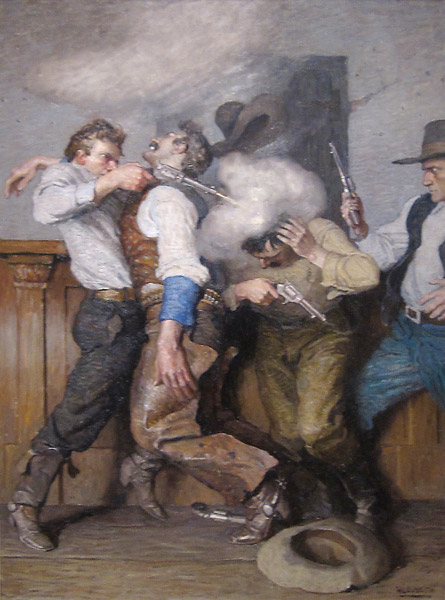
This is N.C. Wyeth’s Gunfight (1916. Oil on canvas, 34″ x 25″), a piece that really caught my eye when we were going through the museum. I’ve seen a number of Wyeth pieces in museums now (including the Benjamin Franklin work at the Amon Carter Museum in Texas), and I always have to stop and look at them.

One thing I’ve read while getting information on Gunfight is that Wyeth’s work here seems staged, as if it’s in a play.  That’s not unusual for Wyeth as far as I can tell, I’ve seen quite a number of his works that seem to have that feeling.

For me though, I don’t really consider that a bad thing.  I see it more as Wyeth’s composition technique, using the more plain or set background with the complexity in front of it to give the viewer a faster, easier sense of what is happening in the scene.  As Wyeth’s works often accompanied a story, it’s a fine balance that the artist has to deal with.  The illustration adds depth to the story and gives a better understanding of what’s going on, but it also can’t interfere too much lest the reader stop reading along.

It’s a little harder to tell in my decently fuzzy picture above (I couldn’t find a larger one, though the intent is all there), but Wyeth uses a nice contrast and color palette in the work. The blues and brighter white areas bring your eye right to the action, and add to the overall sense of excitement in the otherwise drab palette of the background.

It’s definitely an action piece, more “pulp” than what would normally be considered fine art.  It’s a romanticized, almost staged battle, but that doesn’t throw off the effect at all.  It brings you into the fight, into the adventure, and does what a good illustration ought to do.  It makes you want to finish the story, and find out what happened once and for all.

Opinions?


Tags: , , , , , , , ,

I’ve been thinking of doing this for a long time, and today I did.  I’ve had a skull up on my desk for years as an anatomical reference, especially for the more difficult ideas I come up with.  It’s sometimes a pain to hold onto it, or try and balance it on the big pile that usually sits on my desk, so I decided to try this.

I picked up a cheap “goose-neck” lamp at Target ($10), one that clips on to the side of the desk.  I snipped the wires for the lamp, cut some of the lamp shield off of it, and bolted (with the remnants of the shield) the skull onto the now-empty goose-neck.  With a little more wiring around certain parts, and a wire to hold the jaw down if I need it, and BANG! Anatomical skull reference.

Now I have a nice reference skull that I can move around into the position or angle I need with little fuss.  I can also (with a slight bit of work) take the skull off and put on a styrofoam manikin head that I picked up for a couple of bucks last halloween, as a different sort of reference.

Now that it’s finally done, I’m off to do some sketching.


Tags: , ,

I’ve been trying to sketch quite a bit more lately, I agree with the mantra “Draw! Draw! Draw!”.  It’s been difficult in the past to make time for sketching, especially when I have other (paying) projects going on.

I think it’s an important step to learning though, and I want to be a far better artist so it’s time to practice more.  The image above is a sampling of some of the sketches I’ve done.  Upon looking at them, it’s fairly obvious that I have quite a chaotic mind.

As a footnote, the “cartoony” characters are a means to an end.  There’s something in the future that requires I lay aside my more illustrative/painterly abilities, and just leave in line art.  That’s a tricky thing for me, after almost ten years now of learning how to make things more painted, more “realistic”.  To go back and re-learn how to just let a single line say it all, it’s tough.

Then again, I’m probably just a big baby.


Tags: , , ,

Powered by Wordpress
Theme adapted by Russell Dickerson from BlueMod (blueblog_DE Theme by Oliver Wunder)
Original Theme © 2005 - 2009 FrederikM.de

Switch to our mobile site