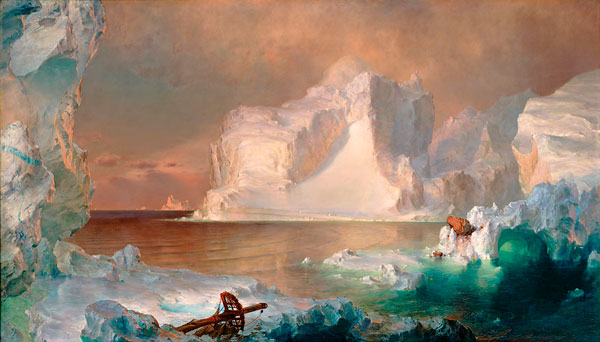
This is Frederic Edwin Church’s The Icebergs (1861. Oil on canvas, 64-1/2″ x 112-1/2″, large size here), and for most of the people who read this blog (anyone? anyone at all?) you may be reminded of Dan Simmon’s recent book The Terror.

Rightly so, as both were influenced (or actually, about, in the case of the book) by the ill-fated Franklin expedition. Though the painting itself is not directly about the lost Franklin expedition (ok, go read about it here, I’ll wait…), Church certainly had it in mind when he painted the picture.

Unlike most of the images I’ve featured here, this one doesn’t have the impact of having an actual person or character in it.  But what it lacks in an actual character it more than makes up for in the inference that people have been here, and seem to have met an untimely end.

In many images of the colder areas of the world, the ice and surrounding terrain are simply part of the landscape, and in fact Church does that here as well in the top left side of the image.  He uses warmer colors to show the area at sunset, and, even in the apparent cold, there’s a warmth here in his palette choices.  The work is soft, almost inviting.

As you work your way down and to the right, any feelings of warmth or comfort give way to darkness, and a strong sense of foreboding.  Church’s hues change radically from warm to cool, the harsh, alien blue of the ice tossing out whatever softness existed above it.

Church also used detail work and contrast to his advantage, much in the same ways he used color.  The loose, soft brush strokes of the easy afternoon above give way to the sharp, high detail of the foreground.  The ice becomes sharp and imposing, the soft waves become hard, as you are lulled from the calm waves to the death on the ice.

The seemingly forgotten mast in the lower right is more the icing (sorry, had to be said) on the cake.  It’s not a forceful detail, it’s a small piece of a massive work (almost 10 feet wide), but your attention goes right to it.  This is the lost expedition, a tiny bit left within a humongous nature.

What I like most about this piece is that it tells you everything without bashing you in the face with it. Church used colors, contrast and minor details to create a very dramatic piece.  It’s up to the viewer to decide how harsh it is really, whether it’s the horror of the expedition’s destruction, or perhaps the peace of the men within after their fall.

Opinions?


Tags: , , , , , , , ,

For my day job, we’ve used a number of my photos for computer wallpapers.  I thought I would post them here too, if anyone wants them.

Little Rock Bridge
Lincoln Memorial
Cathedral, Santa Fe
Washington National Cathedral
Wilson’s Creek National Battlefield
Parthenon – Nashville
Church in Portland, Oregon

Feel free to use them on your personal computers, just don’t post them anywhere as yours of course.


Tags: , , , , , , , , ,

I thought I would return to the pulp art era again, I have a wonderful book by Robert Lesser called, simply, Pulp Art, which is fantastic. I think many of the artists in the book really set the stage for illustration art ever since, and I wanted to write a few blogs about them.

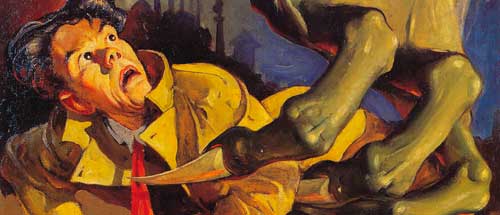
This is Edd Cartier’s cover for Unknown Fantasy Fiction, December 1939, and is a striking piece in both execution and in idea. There’s a real dramatic sense to the art, and it really would pull me in to read what’s inside.

I like Cartier’s use of color and contrast here. I think the bright yellow of the man’s jacket in the foreground fades nicely back along the green arm, back into the darkness.

There’s a real sense of depth here, and of a sense that (aside from the obvious claw) this isn’t a normal scene. Cartier uses the brightness and sharpness in the foreground to really help give us a sense of scale, letting the background blur and fade out nicely.

I like that the character’s face has a uniqueness to it as well, and that it’s not necessarily a “production” face.  You come away with the idea that this is an individual, that there’s a story here to follow. Cartier doesn’t just give us a generic victim, he gives us a unique person with a unique (although probably shortened) story.

Above all though, I just like the idea of the art and how it was executed.  I see it that this poor guy was knocked down, and was getting up in relative safety while the events in the background unfold.  As he starts to get up BAM! GIANT GREEN HAND TO MESS UP YOUR NIGHT!

That’s what I like about many of the pulp pieces, and especially this one.  There’s a story here, something that happened, or is about to happen (poor guy). If I saw this cover nowadays I would be drawn right to it, and in a cover you can’t ask for anything else.

Opinions?

ps – The image above comes from Lesser’s Pulp Art book, which is a fantastic tome on the sometimes forgotten, but brilliant art of the pulp era.  I highly suggest you pick it up, try here for starters.


Tags: , , , , , , , , , , , , ,

Just in case anyone out there wants them (I’ve had a question here and there on it), I saved a number of my art pieces as computer downloads.  They appear on my website’s navigation, and they include:

Feel free to download them and use them on your computer, and your work computer, and your friend’s computer, and…


Tags: , , , , , , , , , , , , , ,

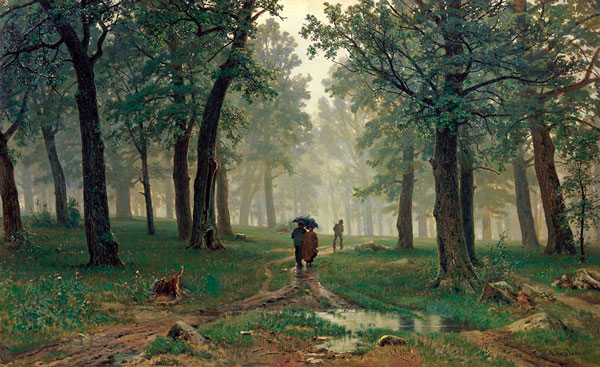
I was actually doing some searching for a few pieces by Vasily Vereshchagin (who I’ve blogged about before), and I decided to look around a bit at some of the other Russian artists.  I came across the piece above, Rain in the Oak Grove by Ivan Shishkin (Oil, 1891), and I knew I’d found a new piece to talk about.

In the day and age of the Thomas Kinkades of the world, it bears remembering that the techniques and ideas of those “modern” landscapes are based fully on those that came before.  In most cases (watch out! opinions!) the paintings of the past are far more interesting than the “kinkade” effect of the last decade.

Here is a piece that’s nearly one hundred and twenty years old, but has so much more emotion to it than many similar landscapes of the current age.  There’s a palpable sense of being there that Shishkin brings to the piece, and you can easily imagine yourself here, in the forest, wandering quietly behind the other group.

The composition breaks one of the big cardinal rules that you often hear, to stay out of the center of the piece.  The idea is that keeping the interesting part of the image in the center makes it less interesting, less dramatic.  But I think Shishkin made up for it by keeping the overall image in thirds, and by having the center be so much more inviting. The path, the leaning of the trees, even the leaning of the characters (namely the front runner) all give you a strong sense of direction, as if taking you by the hand and leading you through the forest.

I like the color palette here as well, especially as the piece is about being in the rain.  There is a sense of bright colors, and a brighter sky, but there’s also a sense that the color is being gently subdued by the rain.  Shishkin really gives a sense that you are in a rainy forest, and the color choices help to quietly nuance the effect.

For me, Shishkin really captures what it’s like to be in nature here.  It’s a scene that’s neither too light or too dark, too happy or too sad, or simply too much.  Shishkin created an enticing, real-world feeling, where nature isn’t good or bad, but just is. He’s leading you down a nice, gentle path in the rain, and it’s easy enough to follow him.

Opinions?


Tags: , , , , , , , , , , ,

I decided to update my Deviant Art page (at audentiori.deviantart.com), and I thought I’d post the revised art here as well. They are all simply duotoned and recolored for a different purpose, but it brings them each a different look and feel too.


Tags: , , ,

Powered by Wordpress
Theme adapted by Russell Dickerson from BlueMod (blueblog_DE Theme by Oliver Wunder)
Original Theme © 2005 - 2009 FrederikM.de

Switch to our mobile site