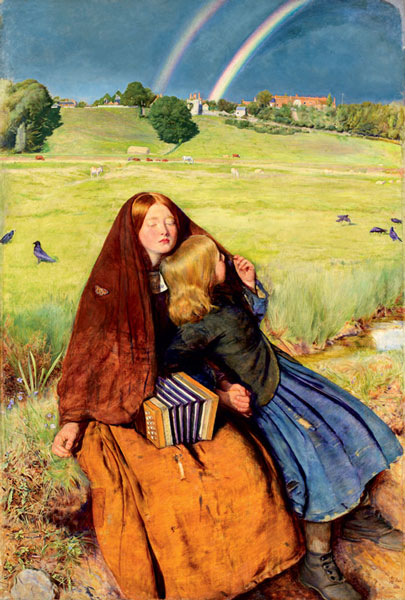
We’re back on a single piece of art this week (since I couldn’t decide on a different topic), this time it’s John Everett Millais’ The Blind Girl (Oil on canvas, 1854-1856, 32 1/2″ x 24 1/2″). It’s one of those pieces where the title really does impact what you see in the image, or at least makes it clear.

It’s an image of duality, of great beauty but of disturbing meaning.  A first glance is a visual feast, showing the beauty of nature, the unusual double rainbow that’s hard to come by in real life, and even the beautiful butterfly on the girl’s shoulder.  But it’s there that you start to realize that the girl in the orange dress can, cruelly, never enjoy the beauty around her. She is blind, and will never know the wonder that it around her. Even the smaller girl in her lap is a cruel twist, as she is fascinated by the environment, alone in her wonder.

Millais really uses a nice color palette and the contrast of the art to set a gorgeous scene.  Bright blue skies, ever flowing fields of green, even the brighter (if worn) blue dress of the smaller girl give such a bright sense to the art that you can’t help but think of a perfect day.  Even the blind girl’s dress is a soft shade of orange, almost teasing her with the brightness she will never see.

For me, Millais’ work always has wonderful detail work, and usually in natural settings. This one is no different, as Millais offers not only great details in the foreground, but a nice, even detail through the background as well. It’s not overpowering, but gives a sense of reality to the work.  What works best is that Millais knew where to soften that detail, knowing that the lack of details in the right areas will enhance the piece.

What I like most in the piece is just the idea that a second look at it, with more information, really sets it apart.  Many might just walk right on by it, noting the beauty of it and moving along.  It’s only on further thought, on further knowledge, that we find out that sometimes even the most beautiful things can really be dark.

Opinions?

Russ


Tags: , , , , , , , , , , , , , , , , , ,

This week, I’m talking about artist Gregory Manchess (www.manchess.com), one of those artists who seems to be able to fit into any genre. Whether it’s work for movies or television, books or magazines, or even just fine art, Manchess has a great ability to capture different ideas in interesting and exciting ways.

If you happen to see the latest National Geographic Magazine in the store (February 2008), you’re getting a look at Manchess’ work.  Along with the cover, Manchess created artwork for the lead story, on the black pharaohs of Egypt.

Which leads me to my first point about Manchess’ art, his ability to capture historical accuracy within an otherwise loose palette.  Manchess’ art has a certain “impressionistic” sense to it, with looser brush strokes and the idea that the viewer can fill in some of the details themselves.  But within that, he is able to add enough fine detail (or the hint of it) that you get the feeling of the art being complete, as if this were just a painted version of reality by an artist right on the spot.

Manchess also is able to give nearly any scene the idea of action, of the scene being just a split second of whatever is happening.  Part of that is in the brush style, but much of it is in the way that Manchess uses composition, color and lighting to give the sense that this scene is a moment from life, that life is in progress here and we’re getting a glimpse at it.  Even in his still life work, it feels that there is action, and thus emotion, at play.

For me, Manchess reminds me every day that there are different ways to approach art. The image at the bottom here (from the Spectrum poster, “Something Wicked This Way Comes”) sits above my desk at work, and tells me that not only should I always explore different styles, but that with just a flick of the brush here or there any image can become fascinating.  Manchess is a true artist, and one of my personal favorites.

Opinions?

Russ


Tags: , , , , , , , , , , , , , ,

Powered by Wordpress
Theme adapted by Russell Dickerson from BlueMod (blueblog_DE Theme by Oliver Wunder)
Original Theme © 2005 - 2009 FrederikM.de

Switch to our mobile site