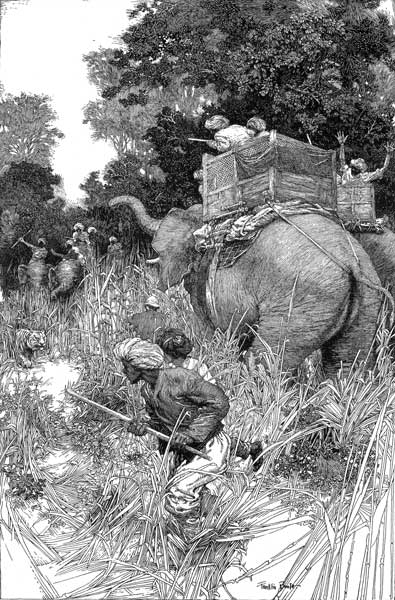
This week we’re back to a piece of art, in this case Franklin Booth’s War on the Tiger (ink, 1908). I’m a huge fan of ink and engraved works, and Booth was a master of the pen.  He is one of the most influential ink artists ever, and his techniques and styles can easily be seen among the best of today’s pen and ink artists.

I happened upon a book about Booth last week, called Franklin Booth: Painter with a Pen, and I think that’s a perfect way to describe his work.  This piece, War on the Tiger, really stood out as soon as I saw it.  It’s a great exercise for ink artists to examine, a wonderful piece that defines perfection in inkwork.

One of the toughest things about doing inkwork is the balance between the detail work and the contrast of the overall image.  Often inked works will suffer from too much detail, and the overall idea or image that was intended is lost in the process.  In this image, Booth shows how to work with the dark and light images of the overall work, and yet not lose detail where it matters.  The lightness in the lower left corner compliments the darkness of the upper right, and both converge right where the action is, at the tiger.

In fact, all of the action in this piece is aimed squarely at the tiger.  The people and animals are all pointed towards it.  The inkwork is designed to lead your eye to it.  Even the strong details and areas of light details all converge at the same spot.  This is actually where Booth succeeds, his greatest idea of all.  He’s built tension in the image, mostly in your subconscious, and his techniques give you a sense of urgency and of swift action that is difficult to pull off.

For me, again a big fan of inkwork, his draftsmanship is beautiful.  From the delicate linework in the character’s clothing, to the detailed look of the far off forest, to the intricately balanced but clean grasses in the foreground, Booth shows a masterful control of the ink and line.  That’s certainly an artist’s sight, looking at the linework and technique.  But I think Booth gives a nice, clean look to the whole piece, which anyone can appreciate over a messier, but maybe even further detailed piece.

Above all, Booth gives you a sense of the scene and of the action long before you start noticing technique.  This is a moment of truth, the men against the tiger, and within the grasses and natural environment seemingly against nature itself.  You get the excitement of the scene, the tension of the story within, and you can ask nothing more from a great artist.

Opinions?

Russ


Tags: , , , , , , , , , , , , , , , , ,

On the road of the new and improved (or at least different) “This Week’s Art” posts, this week I thought I’d talk about an art term.  Partly for those who may not know what it means, and partly because I get to learn a little too.  This week’s art term/word is “Trompe l’oeil”.  No, I can’t pronounce it either [edit: it's pronounced "tromp loy", according to sources].  But as an effect in art I think it can be dazzling, and when used in combination with real life objects can be fascinating to behold.

Well, what is it?  Trompe l’oeil is, to me anyway, bringing an alternate reality to our own real setting. The french term itself means, “trick the eye,” which is exactly what it does using perspective and other artistic trickery. It can take many forms, from small paintings on canvas to the largest buildings, and is created to give the realistic illusion of some other reality.

For example, in the rather ornate church image (at right/above; Jesuitenkirche, Vienna, Austria), the beautiful and ornate dome doesn’t really exist at all.  In 1703, Andrea Pozzo created the painting of just the interior of the dome on a nearly flat section of the ceiling. Pozzo created a number of works using the technique, including several more churches in Europe.

Even recently, the effect is being used to enhance what would be otherwise drab walls and other areas.  Artist John Pugh (www.illusion-art.com) has created a number of monumental designs, including several of my favorites.  The one I have here at the bottom of the post, with the columns behind the seemingly broken wall, is on the side of Taylor Hall on California State University’s campus (1981).  On this page here, you can see a final image of the “Cafe Trompe L’oeil” in San Jose, California, and an image right below it of the work in progress.

Trompe l’oeil doesn’t necessarily have to be enormous either.  Henry Fuseli (aka Johann Heinrich Füssli) created a piece only 49 cm x 37 cm, called, of course, “Trompe l’oeil” (oil, 1750). The image is of a piece of paper with a sketch on it, hanging on a board.  Much like the larger works of the technique, the smaller image can really force a double take in real-life, and make someone stop and look at the art.

There are many more examples of the technique, and for me they are not only fun to look at, but also really make me think about perspective and how it can work in a two dimensional medium.  Many of the Trompe l’oeil artists pull off what many other artists are looking for: getting the viewer to forget for a moment about the technique and getting them to focus willingly on the art, and how it makes them feel when they see it.

Opinions?

Russ


Tags: , , , , , , , , , , , , , , ,

As I mentioned last week, I’m hoping to change things up a little with the art blogs, and offer more than just a “piece of the week”.  I’ll be featuring artists sometimes that you may be familiar with, if not in name than in work.

This week, I’m going to talk about Michael Deas (www.michaeldeas.com), an artist who has done some fantastic work.  Many of those in the horror community have seen his cover of Richard Matheson’s Hell House, or of one of the editions of Anne Rice’s Interview with the Vampire. Nearly everyone has seen his iconic Columbia Pictures logo as well.

Deas has been featured in many of the award compenums, including Spectrum and the Society of Illustrators.  One of my personal favorite images is the Hell House cover, which is striking.  It has a certain darkness to it that’s hard to capture, and the chills it invokes are just what an artist is looking for in such a cover.  At the same time, Deas is able to convey lightness in a work, almost an iconic imagery at times that’s truly opposite of the darkness he can also create.

His work has been featured in many different types of projects, not just in genre work. Many of his portraits can be seen on U.S. Stamps, including Hollywood stars, former presidents, historical characters and more.  He brings each character to life, seemingly not just a picture of a moment in time, but of the essence of the person.

Deas also has an eye for humor, as can be seen in some of his magazine work.  He also worked on a calendar for restaurant chain Chick-Fila, featuring “Cows in History”.

Overall, I think Deas brings a heart to his work, and offers many pieces that just need to be seen to be appreciated.

Opinions?

Russ


Tags: , , , , , , , , , , , , , , ,

After a busy (and depressing) holiday season, I’m attempting to restart the art blog idea.  This time though, I’m going to work things a little differently. Instead of just a piece of art each week, I’m going to alternate on artistic ideas.  Some weeks will still be about a certain piece, other weeks about artists or books/graphic novels, and other various art-related themes.  Hopefully people will still tune in.

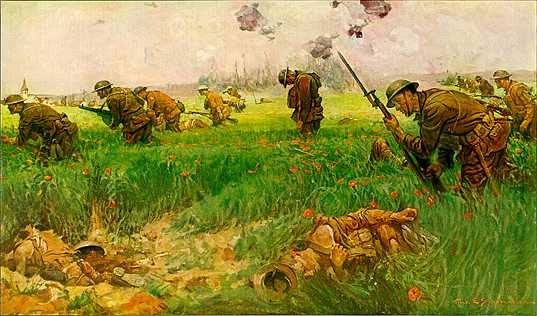
For the first of the new year, I’m talking about Frank E. Schoonover’s “Assault on Belleau Wood“, also known as “How Twenty Marines Took Bouresches” (oil, early 20th century). Schoonover was one of the great illustrators of the early 20th century, a student and friend of Howard Pyle.

In this piece, Schoonover shows a battle from World War I (information on the battle can be seen at http://www.worldwar1.com/dbc/ct_bw2eng.htm), and also showcases his wonderful abilities at realism and storytelling. There is a sense of action and tension in the art, as if we are seeing a certain moment in the story. The men all seem to be waiting for the next shot, the one that might have their name on it.

Schoonover does however give the scene almost a moment of pause to reflect on the dead at the front of the scene.  The body towards the left seems to have been there before, but the one in the foreground (right) seems to have just fallen, as indicated by the man directly above him.  Schoonover has succeeded in giving us a realistic moment of time, and includes the complexity that a real moment would have.

I like the composition of this piece quite a bit, I think Schoonover really draws in the story with it.  The open area between the lines of men is almost the line between life and death. The open, lighter area gives way to the dark figure in the center, one that we assume is either hanging on or has died right as the moment happened. The composition also curves in all respects towards the left, as if saying that the men are all moving forward, regardless of what’s about to happen.

I can’t speak to the color too much unfortunately, there are several versions online and the colors are slightly different in each.  In each though (especially in this version) there seems to be a brightness to the grasses and flowers, to me saying that horror and darkness can invade anywhere.  Even in the beauty of nature, the darkness of war can come.

Opinions?

Russ


Tags: , , , , , , , , , , , , ,

Powered by Wordpress
Theme adapted by Russell Dickerson from BlueMod (blueblog_DE Theme by Oliver Wunder)
Original Theme © 2005 - 2009 FrederikM.de

Switch to our mobile site