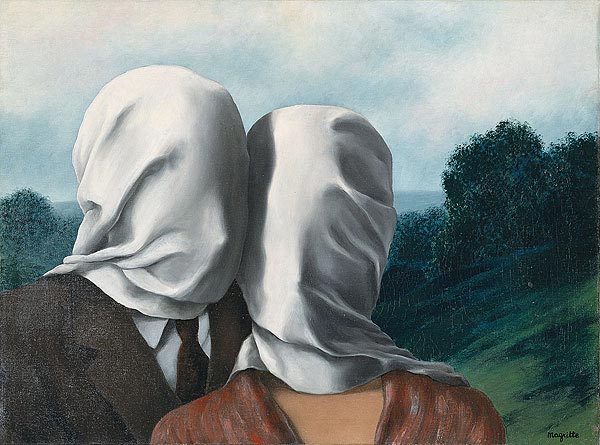
Here’s another of the images that I posted on the Message Board of the Damned so long ago.  This is Rene Magritte’s The Lovers (1928, oil, 21″ x 29″, aka Les Amants), a piece which I’ve had ready to post for some time, but decided to hold onto. It’s just such an interesting, disturbing piece (maybe) that I had to finally write about it (well, again).

Magritte’s image is probably one of the most open to interpretation that I’ve ever seen.  It can really be taken in just about any context, and the experiences of the viewer play a great part in that.  Think about it for a second.  Take a good, long look at the art.  Once you’ve had your good long look, close your eyes and imagine the art again, and imagine what just happened before the scene and after.

I’ll give you a moment.

I’ll bet that the ideas you had in your head are fairly different from mine, and from everyone else’s.  Magritte’s magic here is that the meaning behind the image is completely left up to us, and whether those ideas are light, have meaning, or are even dark.  Are the lovers just goofing around in front of the camera?  Is it a message about anonymity?  Are these lovers about to be pushed off the train, and this is their last goodbye?  It’s a fantastic work of the idea and of the content of the piece to keep everyone seeing their own stories.

What Magritte did beautifully too was to keep it simple.  The color palette is subdued, so no one color is distracting.  The detail is kept simple, even the background could be anywhere at nearly anytime. It’s level on the contrast, even the highlights on the shrouds aren’t fully white. Magritte made sure that none of the other elements of the art were distracting, they all work together so smoothly.

Magritte often had unusual, strange visions in his art.  He created ideas and worlds that were odd, and yet somehow approachable.  The Lovers is a great example of that, a work that anyone can make up their own mind on themselves.  Is it dark?  Is there a message? Is it all in fun?

It’s all up to you.

Opinions?

Russ


Tags: , , , , , , , , , , , , , , ,
Aug
24.

I know these have been posted before, I’m just behind on the times.

Your results:
You are Malcolm Reynolds (Captain)

Malcolm Reynolds (Captain)
70%
Zoe Washburne (Second-in-command)
65%
Dr. Simon Tam (Ship Medic)
65%
Wash (Ship Pilot)
60%
Jayne Cobb (Mercenary)
50%
Alliance
50%
Kaylee Frye (Ship Mechanic)
45%
River (Stowaway)
45%
Derrial Book (Shepherd)
30%
Inara Serra (Companion)
25%
A Reaver (Cannibal)
20%
Honest and a defender of the innocent.
You sometimes make mistakes in judgment
but you are generally good and
would protect your crew from harm.


Click here to take the Serenity Personality Quiz


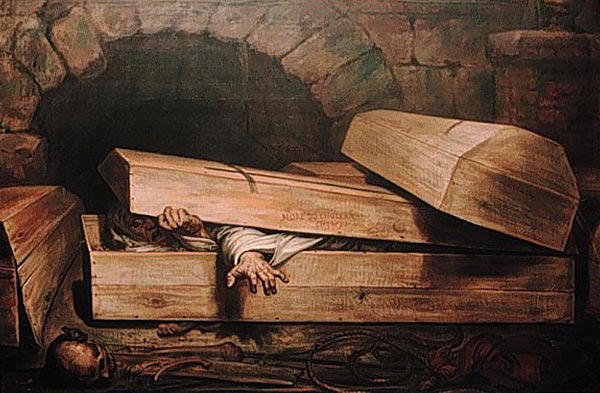
The fans of Edgar Allan Poe out there should like this one (not that they are probably reading my blog, but it’s worth a try). This is Antoine Wiertz’s The Premature Burial (1854, media/size unknown, aka The Hasty Burial), a piece I first saw many years ago accompanying Poe’s work by the same name (which was painted several years after Poe’s death).

Wiertz’s work often treaded on dark, horrific imagery, as a number of artistic and literary works of the time did.  This one actually is fairly light for him, compared to graphic images like Last Thoughts and Visions of a Decapitated Head or The Outrage of a Belgian Woman. There was quite a bit of concern in the mid-19th Century about premature burial, and this one certainly shows the horror of the event well.

In this image, the victim is a cholera victim (as evidenced by the text on the coffin) that doctors were seemingly unwilling to get close enough to really test. The content of Wiertz’s piece really shows an idea of story here, and that this person probably isn’t going to go anywhere.  The skeletons on the floor, the dilapidated coffins around him, and the coffin on top of his all give a sense of not only the terror of such a moment, but of the idea that no one is coming back to help.

Wiertz used a nice composition to highlight where your eye should be drawn.  The stone arch, the coffin on top of the victim’s, even the broken coffin to the left all lead your eye back to the man desperately trying to escape.

I also like the use of light here, and actually the lack thereof where it matters.  You are drawn to the arm coming out of the coffin, but that’s just the drama of the moment.  It’s in the subtle darkness of the rising coffin lid that the real meaning of this piece is shown.  With the most horrifying part of the image well within the darkness, the viewer’s eye is drawn into the interior of the coffin, forcing you to not just look at the horror, but to examine it thoroughly.

Of course the image reminds me of the great EC comics of the 50′s, and of much of the ideas of horror that I’ve seen in various works.  Wiertz’s powerful image is one of horror and desperation, and is a reminder that we may wake up to an unexpected horror at any time, when we least imagined it possible.

Opinions?

Russ


Tags: , , , , , , , , , , , , , , , , , , ,

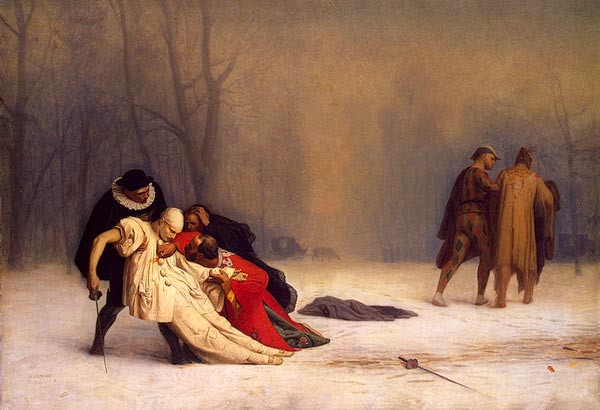
This is Jean-Léon Gérôme’s The Duel After the Masquerade (1857, Oil, 20″ x 28″), a piece I came across when I was actually looking for another of his works (this one, which may come up again in the future).  It struck me as an interesting piece, and a much different palette than many of Gérôme’s other works.

The setting is pretty much explained in the title, we are seeing the aftermath of the duel. The man’s shocked friends hold him helplessly, and it’s one of the more interesting and eye-catching poses I’ve seen.  Gérôme has plenty of choices in the way he sets the characters, but (as in many of his pieces) he chooses a very unique, almost startling pose.  We don’t need the title of the piece at all to tell us what has happened, and that this man is in the last seconds of his life.

Gérôme almost removes all of the vibrant colors he normally uses, save for the stark red.  In an otherwise neutrally toned piece, the red of the man’s jacket stands out strongly, and leads your eye perfectly into the small red slash on the dying man’s outfit.  Gérôme uses the palette brilliantly, and even though there are the men walking away and the dark jacket and robe standing out to the right, your eye is immediately drawn to the drama on the left through that bright red and the brighter contrasts and colors.

Gérôme’s composition is the final addition to a nice piece.  The characters to the left are larger, and more highlighted, while the men on the right, the victors, almost pass into nothingness. The drama to the right has passed, and we are here to bear witness to the final dying drama of the man on the left.

Opinions?

Russ


Tags: , , , , , , , , , , , , , , ,

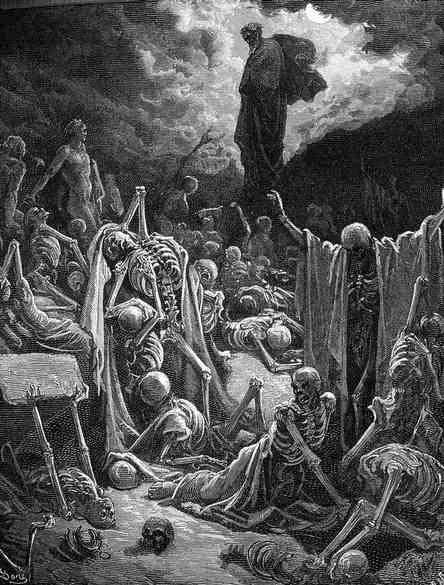
This is Gustave Dore’s Rising of the Bones (aka, Vision of the Valley of the Dry Bones, 1865, engraving), a masterwork by one of the greatest engravers and artists that I’ve yet come across.

When I started being an artist, there were certain works and creators that I was really influenced by.  Artists like Michael Whelan, and Frank Miller, and maybe none more than Dore.  Most of my first works were scratchboard or pen & ink, and to look at Dore’s works was to see everything that I wanted to do.

This particular piece is probably one of the few religious pieces you’ll get out of me (I can’t say as I’m much of a religious person), but I can’t deny Dore’s brilliance.  This scene is one of the many fantastic biblical works that Dore produced for his version of the Bible, perhaps the most sought ever version in the 19th and early 20th centuries. It depicts the prophet Ezekial from the Old Testament, as the bones reanimate back to their human form.

My favorite part of this image is that each character is seemingly unique.  There are no shortcuts here, each reanimated body brings on a life of it’s own, separate from those around it.  It’s an awakening from death, and Dore balances the horror of the idea with the sense that this is truly meant to be. He uses the light in a zig zag through the center of the piece, as if forcefully pushing aside the darkness all around.

The image really highlights all of Dore’s strengths.  There is the immense detail work that he’s known for, a great balance in the white and dark contrast of the work, and a composition that wonderfully ties it all together. Above all it’s a great story illustration, a moving piece that’s a perfect choice to accompany the work it illustrates.

Opinions?

Russ


Tags: , , , , , , , , , , ,

Powered by Wordpress
Theme adapted by Russell Dickerson from BlueMod (blueblog_DE Theme by Oliver Wunder)
Original Theme © 2005 - 2009 FrederikM.de

Switch to our mobile site