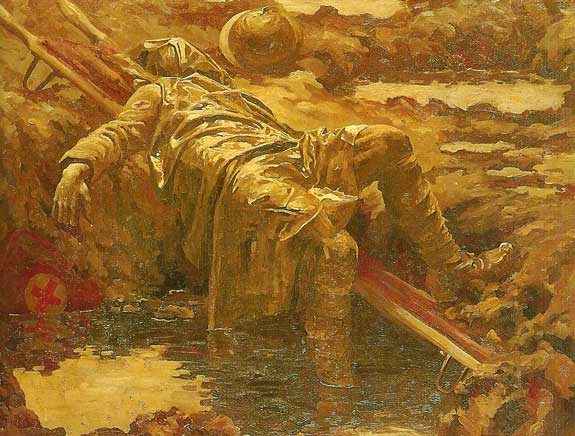
I’m back from the brief hiatus known as the Northeastern Writer’s Conference (NeCon), and I’ve chosen a piece that I haven’t come across before. This is Gilbert Rogers’ The Dead Stretcher Bearer (1916, size and media unknown, possibly oil), a fairly disturbing war piece.

Now, before I get too far ahead, the version above is the one I think is color accurate.  I also found one here that seems differently colored, but also seems to have the tell-tale signs of being a photo of the piece with heavy flash.  If anyone can correct me on it, please do.  Otherwise, especially since the above is consistent with many of Rogers’ other pieces, I’ll consider the above accurate. If you are in the UK, swing by the Imperial War Museum and let me know what you think. It’s a bit far of a jaunt from Colorado.

Back to the art, this is one of the most realistic, most disturbing pieces of war art I’ve seen.  This isn’t the propaganda piece, or the shot of the victorious boys back from battle.  This is the gritty, horrific realism of the First World War, as seen through the eyes of the artist on site.  Rogers was in the Royal Army Medical Corp, who not only saw first hand what was happening but was also commissioned as an artist to record it.

Rogers fills the art with references to the stretcher bearer, who’s job (as I understand it) was to help the wounded.  Here, the savior has become the fallen himself, and Rogers uses the subdued palette to seemingly make the point that, no matter what you’re doing in the war, it’s only a matter of time before you become part of the horror.  Rogers uses his subdued palette to show that the stretcher bearer here is not above or even below the fight, but has inescapably joined the horror himself.

Rogers uses the composition to always bring your eye back to the fallen man, forcing the viewer to see the unflinching reality before them.  The balance of the highlights in the water holes (assumed to be blown out by mines or artillery), the angle of the stretcher’s ends and subtle use of red in the palette in just the right location bring you back to the man each time. It’s certainly possible that Rogers was painting from real life directly, which makes the piece even more disturbing to think about.

Perhaps the strongest of all is simply the man’s form, complex and yet somehow simple at the same time.  Rogers posed the man in a truly fallen position, equipment dropped at the moment of death.  He has one foot up, as if he was about to continue on helping, and yet the position of his arm and head tell the entire truth. Rogers captured the true horror of war, a gritty realism that sticks to the soul.

Opinions?

Russ


Tags: , , , , , , , , , , , , ,

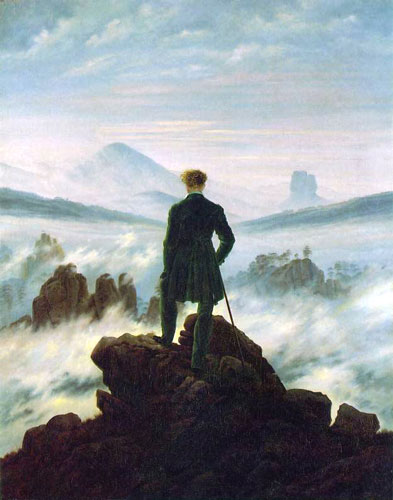
This week it’s one of my very favorite pieces, and one from the previous incarnation of the “This Week’s Art” threads. This is Caspar David Friedrich’s A Wanderer Above a Sea of Mist, a stunning piece for me and one that I will eventually (when I have wallspace) show proudly on my own wall.

For me, this is one of those pieces that shows the pinnacle of what can be achieved in art.  There’s plenty of detail here, but it’s forgotten in the simplicity and strength of the content in the image.  I feel Friedrich was trying to get across what it’s like to have the creative spark inside, to come up to the edge of reality and see that there is far more than you thought was there.

Many have pointed this to be the perfect image for the Romanticism movement of the early 19th century, and I would agree.  The Romanticists wanted to bring emotion and strength back into an art marketplace that had been increasingly becoming more strict and more refined.  They yearned for a looser, more natural, and more emotional vision in art, and Friedrich’s piece here is perfectly representative of that.

We are looking through the eyes of the artist, or at least how he seems himself, and Friedrich uses composition very well to enhance his presentation. The structure and forms of the man, coupled with the angles in the distance, bring your eye right back to the man each time.  He places the full darkness at the bottom of the image, and with the strong light colors above it keeps your eye in check, and aims it where it’s supposed to be.

Friedrich also uses his spare colors and tones wonderfully, and they give an overall sense of depth.  The strong tones of the foreground, what I would consider the artist’s “reality”, give way to the soft, yet breathtaking valley below. It’s a good example of where a small use of color can go a long way.  He uses just the slightest tones for hills and trees in the fog, which grounds us in the creative air of the fog.

For the artist in me, this is what I hope to see in my mind when I’m working on art.  I hope to come up to my own cliff, to the edge of my own reality, and look deep into the abyss.  Friedrich here has allowed just that, a glimpse into the vastness of creativity, and yet a clear grounding throughout.  He seems to say that we must always go the the edge to find out who we are, and that there is no limit to what we might find there.

Opinions?

Russ


Tags: , , , , , , , , , , , , , , ,

Before I brand myself as either only liking realistic art or only posting neoclassic/romantic art, I thought I’d add a little different look.

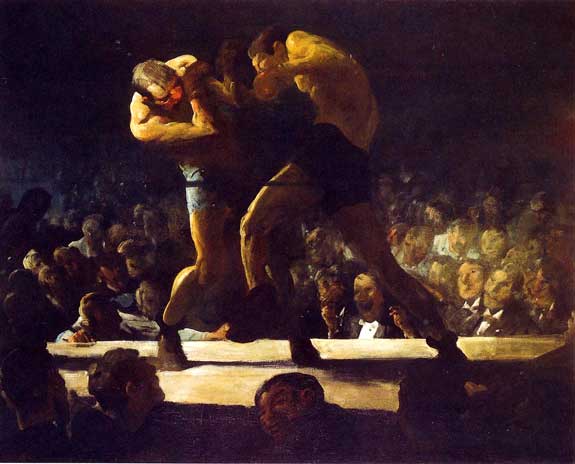
This is George Bellows’ Club Night (aka, Stag Night at Sharkey’s; 1907, Oil on canvas, 43 x 53 inches), a “looser” image than I’ve been posting so far.  Ironically, Bellows also did at least two other boxing images which were much more realistic, but this one stuck out for me.

Bellows’ work here is a study of how to use contrast without resorting to sharp lines.  He used the immense darkness of the arena contrasted only with the strong highlights through the center of the piece.  It draws your attention right to the boxers every time, and no matter where else in the piece you might want to look, you are still drawn right back to center.

Bellows’ composition helps that effect perfectly.  The angles of the boxers and their arms all point in similar directions, and the stage/ring comes to a point from right to left, helping the eye to follow back to the center. Bellows also puts the real center of the piece, the boxer on the left, just off center.  The darkness of the boxer on the right draws you right in, and your eye almost follows the boxer right into the one on the left.

The colors also work beautifully here, a great touch to an already great scene.  The blue in the left boxer’s shorts, combined with the high yellows of his skin, help to bring you to the immediacy of the red on his face.  We understand through the color that this is who we wanted to win, but the great darkness of the other boxer looming over is surely his doom.

Bellows created a masterpiece, and iconic vision of everything the sport is.  The colors and contrast in the crowd are subdued, but the boxers are in high contrast, a battle of light and darkness.  Bellows uses all of his skill to really separate the crowd from the fight. The feeling of being a spectator in the crowd is strong and, though we are here at the scene, we are delegated to watching the epic battle rage.

Opinions?

Russ


Tags: , , , , , , , , , , , , , ,

I’m getting excited, NeCon’s just a little bit away now.  I leave the week after this coming week for it (on Tuesday the 17th), where I’ll spend a couple of days in Boston checking out the sites with Tod Clark.  It should be fun, though I’m not 100% sure what to expect.  It’ll be a nice vacation from the world of real life though.


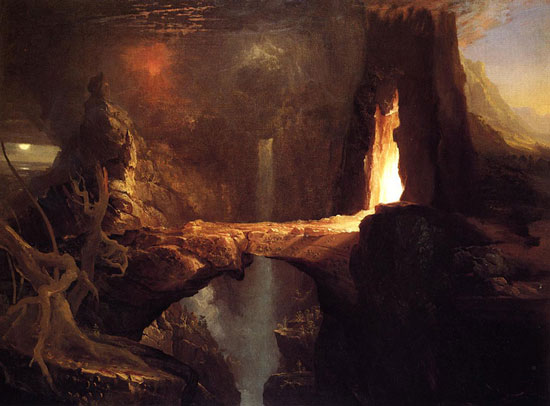
This is Thomas Cole’s Expulsion – Moon and Firelight (1828, Oil on canvas, 35 7/8 in x 47 7/8 in), one of those pieces that I find very inspiring.  It’s a bit different than the images by Cole that I normally cite (like his Course of the Empire series, check out http://www.swarthmore.edu/Humanities/kjohnso1/colecourse.html), but it’s an interesting piece.

It reminds me of the modern fantasy works, as if we are peering into Cole’s magical, unique world.  Despite there not being a human element, which is most often found in his work, Cole offers up a dynamic, powerful image that grabs you and doesn’t let go.  There’s a story here, and he leaves the viewer with a sense that they are seeing a great battle of light and darkness.

Cole uses the high contrast in the piece beautifully.  We have a midtone piece throughout, and the dark and light colors all lead to the very bright, seemingly hot gate of fire just off center.  Cole’s use of subtlety throughout the piece is punctuated by the intense brightness of the gate, and it’s as if we can feel the fire itself burning through the canvas.

Cole uses his colors wisely as well.  None of the colors, from the subtle reds, greens and blues around the edges to the rusty rock in the center, ever take over the image.  They all serve the whole piece, a sum of parts all pointing to a dynamic centerpiece of light.

The piece is really a battle of light and darkness, both of which are very strong and at once complimentary and opposing. Cole has brought us through the darkness to the light, from here it’s up to us to follow into the gate of light or fall into the chasm of darkness.  It’s an intriguing piece, one that fires the imagination and stirs the soul.

Opinions?

Russ


Tags: , , , , , , , , , , , , , ,

Powered by Wordpress
Theme adapted by Russell Dickerson from BlueMod (blueblog_DE Theme by Oliver Wunder)
Original Theme © 2005 - 2009 FrederikM.de

Switch to our mobile site