My friend is looking for music/movie reviews for the site that I helped him build, and I thought I’d pass it along to you fine folks.

“Consider yourself a good judge of music? Well aren’t we all? The Culture Shock (www.thecultureshock.com) is looking for someone to write album and reviews from any era. We’d be looking for someone who can devote time enough to write three or four album reviews a month. If you’re interested, bust an e-mail to patrick@thecultureshock.com

We’re also looking for someone who may be interested in writing movie reviews. If that turns your crank, also feel free to e-mail patrick@thecultureshock.com”

Thanks everyone!

Russ


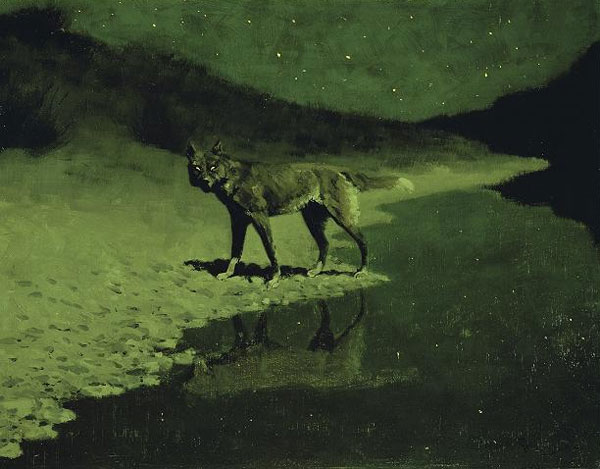
This is Frederic Remington’s Moonlight, Wolf, (1909; oil on canvas, 20 1/16 x 26 in), a bit of a different image from the typical Remington western art you’d see.

Much of the effect had to do with Remington’s life.  Many of his western works appeared before the Spanish-American War, and after he became an artist on the ground in Cuba his work took on a much darker tone.  In this image, Remington has dropped the pretense of watching the scene from the distance.  The viewer is right in the middle of things now, and in fact is in grave danger from the ominous wolf.

This is where Remington’s art had changed, and for me some of his best, most emotional works were around this time.  Remington’s earlier works were often illustrations, especially in war, where the outcome and the story are all there to follow.  But here, Remington only brings the story to us, from there we have to decide whether the wolf will have a go at us or slink away under the cover of night.

I can’t speak to the palette on this one, I found a few different versions online that were all a little different. But I think in the balance of tones he’s done very well here.  The lighter tone of the sand (or beach) follows through the center of the work, and always brings your eye back to the wolf.  The darkness is enhanced by the reflection in the wolf’s eyes, and the viewer is forced to see the power of the wolf and of the unknown in the night.

Living in the west, western artists are often put aside to specific touristy galleries.  They are often seen as only fitting a certain style, and certain topic and a certain time in history.  But I think for the really fantastic artists out there the genre is irrelevant, they are able to bring something else to the table, something extraordinary.  Remington breaks out of the western here with the dark and ominous feel of the unknown, and above all else engages the viewer, making them decide what happens next.

Opinions?

Russ


Tags: , , , , , , , , , , , , , , , ,

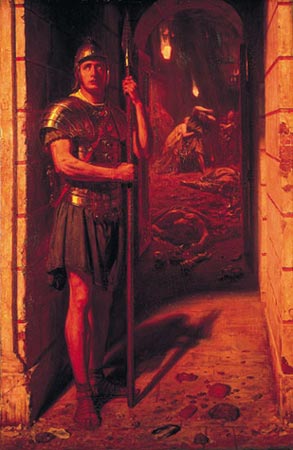
This is Edward Poynter’s Faithful unto death (1865, Oil on canvas, 61″ x 29 3/4″), a piece of art that is not only is a strong image, but shows an accurate and interesting historical uniqueness.

Many of Poynter’s works are historical, and this was one of his very first ones.  The scene has been said to be based on Edward Bulwer-Lytton’s book The Last Days of Pompeii, which was a very influential book in the Victorian age.  On top of that, the Pompeii site was a fairly recent find, and one that was very interesting to the times.

In the image, the lone Roman soldier stands at his post, and despite the fear and concern on his face will not abandon his post.  Even as the people behind him in the courtyard are dying, and coins and purses and other valuables lie at his feet, he stands his ground, ever faithful to the end.

Poynter’s attention to historical accuracy was imitated and copied often, especially after this image was shown.  Remains of Roman armor were found at Pompeii, often in a doorway or hall, and Poynter grabbed that idea of utter devotion and ran with it.

I like the colors and tones Poynter used here.  Nothing is at all bright, and the red colors, like horror brought to life, are infused in everything.  There is no question that this is an image of the end, of an armageddon, and yet Poynter manages to give the soldier real emotion.  His face shows fear and concern, and even understanding.  But the strength in his arms, the stance and the way he holds on tight to the spear shows that he isn’t going to leave, even if it means his life.

This is one of those pieces that looks great, and you could spend a lot of time with the details, but also gives such a strong sense of story and in this case of history.  Poynter shows the great strength of the soldier and of the Roman army, and with the people in the background and the setting of the image shows that destruction has come.  To me he’s saying that when the end comes, no matter how overwhelming, to stand your ground.

Opinions?

Russ


Tags: , , , , , , , , , , , , ,

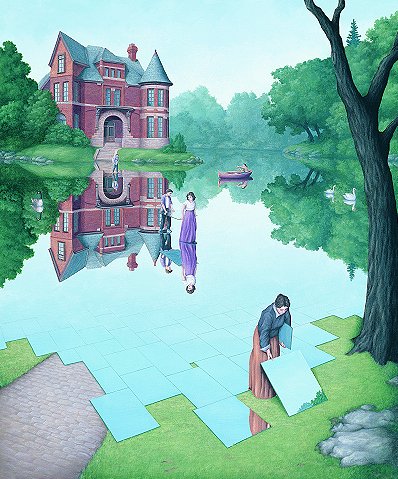
This is Rob Gonsalves’ Still Waters, truly an impressive piece of art.  It’s one of the most interesting styles I’ve seen, and it’s fascinating to look at.

I’ve always loved the unique visions of artists like Magritte and Escher, who seem to be able to easily twist reality and yet keep beauty intact. Gonsalves has certainly done that here, and the technique is described on sites featuring his work as “magic realism”.  I think that’s a great tag for it, it’s art that is completely real if you are looking at either part separately, and as a whole is still seemingly connected despite it’s differences.

It’s impressive alone that an artist has such a good grasp of perspective, and of the “rules” that are taught in art.  The most impressive thing here is that Gonsalves knows exactly what the rules are but where and how to twist them into a dual reality.  It’s as if the two ideas in the picture have melded together, and where they meet or even end is anyone’s guess.

I think the palette he chooses here really helps the effect, and doesn’t detract from it.  It’s a sharp, detailed look, but the colors are soft and engaging.  By keeping the contrast a bit lower your eye isn’t drawn to any particular part, but the whole.  The viewer can easily lose themselves in either reality, or even one of magic.

Gonsalves has created a masterwork, a piece comfortable in both it’s reality and fantasy.  It’s what art is supposed to be: engaging, thought provoking and something that sticks with you for times to come.

Opinions?

Russ

ps – see more of Rob Gonsalves work at http://www.robgonsalves.com/ArtistGallery.asp?artist_id=23&category_id=2


Tags: , , , , , , , , , , , ,

I’m back from a long, long trip to Washington, D.C., with this week’s new art piece. As always, let me know what you think of the art.

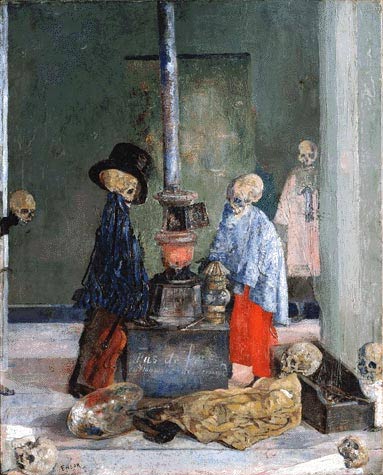
This is James Ensor’s Skeletons Warming Themselves (1889, oil, 30″ x 24″), one of the pieces that I’ve been lucky enough to see in person at a museum.  This work can be seen (or was last year at least) at the Kimball Museum in Fort Worth, Texas.

It caught my eye immediately as I was wandering the halls of the museum (which I was doing slowly anyway, since it was 102 degrees outside).  It was just such a different piece than I had ever seen before.  It wasn’t necessarily grotesque, or even foreboding, in the use of skeletons.  It almost seemed playful, but there there was also a sense of story here.

Ensor’s work fell between several movements, including Symbolism, Expressionism and even Impressionism.  Much of his work was political or had religious meanings, yet he seemed to always mask those ideas behind fantastical images.

The Kimball Museum site explains the image as a cycle in the “dance of death”, a renaissance idea of skeletons portraying the “vanities of a particular profession”*.  I’ll let you read the rest if you’d like (see below), but there is a lot of symbolism and meaning behind it on the official front.

For me (unofficially, since I’m just a schmoe that likes art), I like the look and feel of it.  The colors are well played, bright enough ans set with enough contrast for the scene, but subtle enough to work on their own.  Ensor’s brush is loose, much like the impressionists, but there are strong lines and colors where needed.

I love the composition and the way Ensor played with reality vs. fantasy.  There is a sense that this is a real world scene, that the artists really are warming themselves at the fire.  But there is a strong sense of the unusual too, skeletons that appear out of place or creepily looking on.  Ensor built a piece that challenges not just the rational mind, but offers up the fantastic as well.

Opinions?

Russ

*Information grabbed from the Kimball Museum website (which explains things much better than I do) at http://www.kimbellart.org/database/index.cfm?detail=yes&ID=AP%201981.20


Tags: , , , , , , , , , , , , ,

Powered by Wordpress
Theme adapted by Russell Dickerson from BlueMod (blueblog_DE Theme by Oliver Wunder)
Original Theme © 2005 - 2009 FrederikM.de

Switch to our mobile site