In many a year ago, I was an architectural engineering student.  I loved architecture, but I grew to hate number crunching (which is why I’m a silly artist-type now).  But I still appreciate architecture, and this piece is a fantastic view of it.

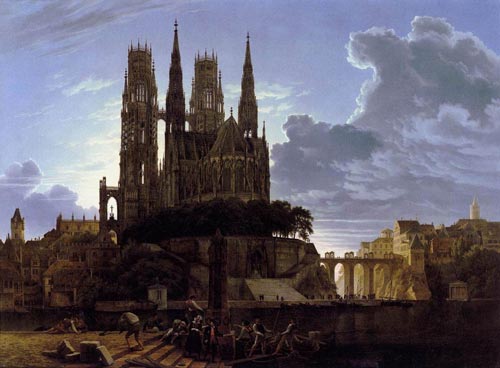
This is Karl Friedrich Schinkel’s Medieval Town by Water (1813, oil, 94 cm x 126 cm), a great architectural piece I came across just today. A piece that for me sits on a nice border between reality and fantasy.

Let’s start with the easy part: I love the cloud work.  The clouds are so dynamic and lifelike, to me more like a photograph.  Schinkel has perfectly captured a moment in time in the clouds, but with a sense that they haven’t stopped any movement at all, the viewer has. They lead perfectly into the cathedral, bound to reality and somehow above it as well.

In dampening the palette of the cathedral, as opposed to highlighting it as other works are, Schinkel has built a powerful structure. Set in the clouds and the setting sun, it sits regally above all else, the fantastical spires ever reaching into the heavens.  Yet, but subduing the palette and giving the cathedral earthy tones, he has also grounded it in reality, grounded it with us mere mortals.

Schinkel does a great job with the immensity of the image, yet through the overall palette and the layout of the piece keeps the view from flying away.  We have everyday people in the foreground, setting reality close at hand.  We have the tiny figures before the cathedral, giving us a sense of scale. Finally, we have the town surrounding the great jewel of the cathedral in its midst, and yet it still seems both above the town and a part of it at once.

Schinkel’s image points to a passion for architecture.  He was a well known architect in Germany at the time, and it seems that if he couldn’t build one to the heavens, he could certainly paint it that way.

Opinions?

Russ


Tags: , , , , , , , , , , , , , ,

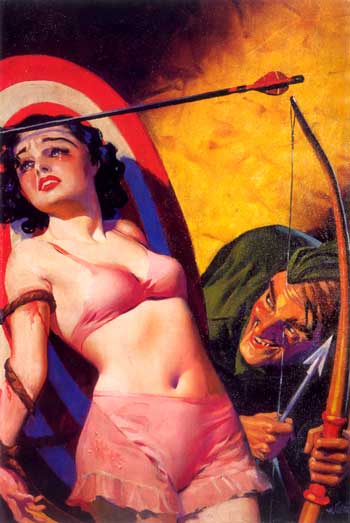
Last year sometime (maybe even the year before, the last few have been a blur) I picked up a fantastic oversized book called Pulp Art ($12.95 no less!). The image above is from the book, it’s a cover of Spicy Mystery Stories Magazine (oil?, 1936) by pulp artist H.J. Ward.

This pulp image in many ways seems like alot of the others that existed at the time.  A dark villain, a dastardly deed, a gorgeous woman in peril, all the makings of the pulp art of the 20th century.  But this one for me stands out, and there’s alot of things that point to a more thought out approach to art that Ward used.

The pulp artists, of course, were illustrating story images, so the covers often showed a part of a story in progress.  In this image, I think Ward captured a great moment in time.  It reminds me of Edward Hopper’s work, where we get to see that something’s about to happen or it just did.  With Ward’s shot here, we get to see that something already happened, and something worse is about too. A nice moment of tension to draw the viewer (and the buyer) in.

The Pulp Art book has a nice “conversation” on the following page to this, and it makes alot of good points on what Ward really did here.  It’s obvious that it shows a heightened sexuality present in the 30′s pulp art covers, but here there’s more to it.  Before the time seen here, this woman has already been through alot.  An arrow almost in the head stands out, but if you look closer (the book points this out, so I can’t take the credit) at her arm you’ll notice something subtle, but disturbing. Her arm is at an awkward angle, and in fact her wrist is already broken.  The “posed” woman from the pulp covers now has real emotion, a broken woman who may get something even worse very soon.

I like how Ward used the layout to his advantage as well, as each object or design we see forces the eye right where he wants it.  The orange/yellow background is a slice of light, bringing your eye through the evil and into the desperate woman.  Angles help in art to allow the viewer visual cues to where they really should be looking, a technique that’s very valuable in comics.  In this cover, Ward uses the technique perfectly, moving the eye where needed without forcing you harshly, allowing you to see for yourself.

I think Ward’s colors and tonal balance are great too.  The colors pop off the page, something important for a book cover.  No one’s going to buy a bland, tonally boring piece of art, and the same thing happens to an extent with books.  If the cover jumps off the shelf at you, especially in a huge pile of other pulp novels, it’s going to get recognized.

The pulp artists are often forgotten in today’s world, and that’s unfortunate.  Underneath the rough and tumble, highly sexualized stories, there was a chance to bring powerful illustrative art to the forefront.  The pulp artists laid the groundwork for the fantasy artists of the rest of the century and beyond, and I think Ward’s cover here is a perfect example of the best in pulp art.

Opinions?

Russ


Tags: , , , , , , , , , , , , , , ,

Death

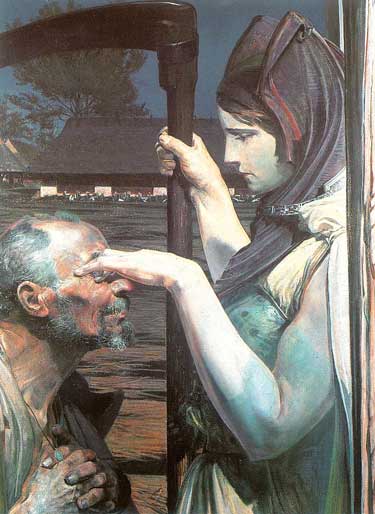
This is Jacek Malczewski’s Death (1902, Oil on panel), and if you were a visitor to the former Message Boards of the Damned you may recognize this piece.  It’s one of my personal favorites, filled with everything that makes a piece of art great.

Malczewski is an important artist in Europe especially, a Polish artist who was very influential.  Many of his works mix history with legend and mythology, and nearly all of his works were symbolic in some way.

I like the color palette that he chooses to use in Death.  The bluish-grayish colors in the work add a different dimension to it, almost as if saying that the man is already dead and this is just formality.  The use of bluish color on the woman, as opposed to the skin color used on the man, really indicates that she is otherworldly, and there is no life there.  The subtlety in using just a hint of the blue in the man’s skin is wonderful, the hint in color a useful hint to the man’s status.

Subtlety is this work’s strongest suit, and in an image where other artists may have boldly declared, “death is here!”, Malczewski plays it quietly. Death herself, though heavily symbolized in the scythe, seems powerful yet gentle, and almost sad in her understanding of her duty. The man seems to understand how things are himself, he is seemingly relieved and also happy to go to heaven.  He clutches his necklace tightly, believing his faith is about to save him as opposed to the darkness that other artists might’ve shown.

This is one of those pieces that I see that is immensely inspirational to my own work.  Malczewski’s use of color, tone and the subject of his work are all fantastic, and it’s a striking image that sticks with you for much longer than just a quick viewing.  It’s an exercise in mixing reality with the fantastic, a great piece of art.

Opinions?


Tags: , , , , , , , , , , , , , ,

Powered by Wordpress
Theme adapted by Russell Dickerson from BlueMod (blueblog_DE Theme by Oliver Wunder)
Original Theme © 2005 - 2009 FrederikM.de

Switch to our mobile site